
blog
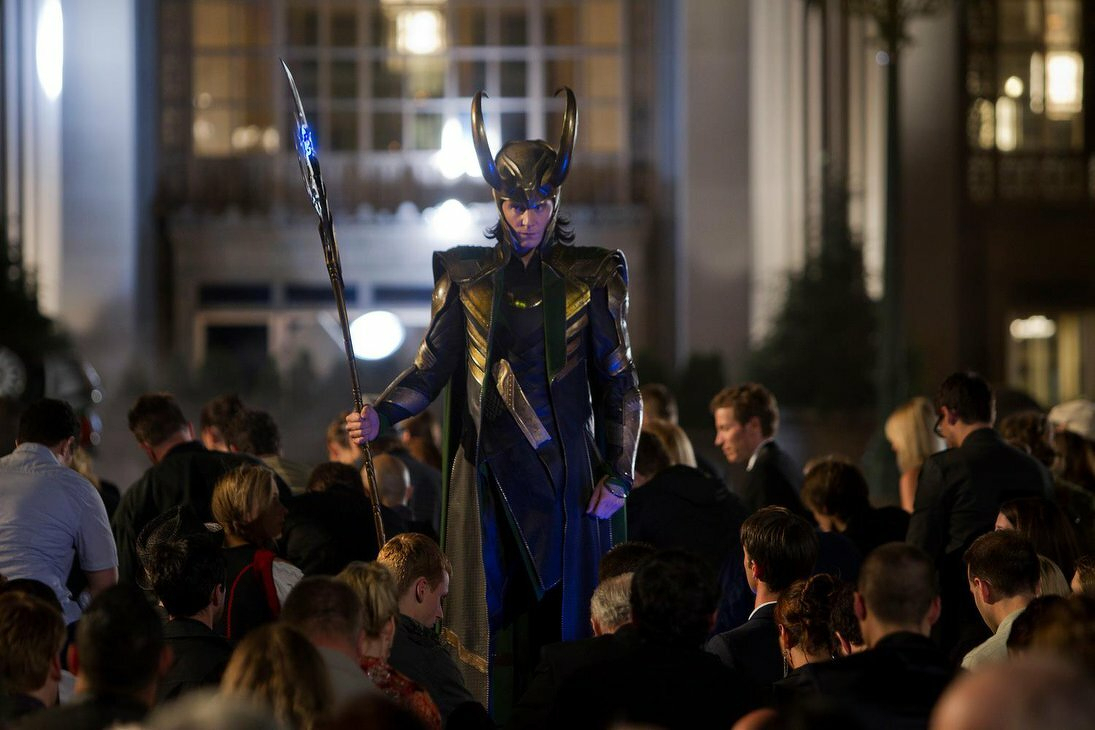
Loki is onto something here
I come with glad tidings, of a world made free. … [Free from] Freedom. Freedom is life’s great lie. Once you accept that, in your heart, you will know peace.
…
Is not this simpler? Is this not your natural state? It’s the unspoken truth of humanity that you crave subjugation. The bright lure of freedom diminishes your life’s joy in a mad scramble for power. For identity. You were made to be ruled. In the end, you will always kneel.
- the avengers (2012)
ministering to my own sores
Seneca, to Lucilius:
I have withdrawn not only from men, but from affairs, especially from my own affairs; I am working for later generations, writing down some ideas that may be of assistance to them. There are certain wholesome counsels, which may be compared to prescriptions of useful drugs; these I am putting into writing; for I have found them helpful in ministering to my own sores, which, if not wholly cured, have at any rate ceased to spread.
It's Good to Be in Love
[soundcloud url=“https://api.soundcloud.com/tracks/472103382” params=“color=#ff5500&auto_play=false&hide_related=false&show_comments=true&show_user=true&show_reposts=false&show_teaser=true&visual=true” width=“100%” height=“300” iframe=“true” /]
Excruciating Information
A fellow autistic blogger whose work I deeply admire pointed me to this short little PSA video from the UK that she said was revelatory in how it reflected her own experience. And so it is for me.
[youtube www.youtube.com/watch
Particularly when it comes to the Asperger’s part of the autism “spectrum,” I think people - including actual Aspies - tend to cling to the idea of social awkwardness and alienation as the defining traits. But using this stereotype as definitive ignores what I think is one of the prime causes of that awkwardness and alienation, and that’s the difficulty we have in processing stimuli with the same capacity and at the same rate neurotypicals, and that difficulty manifests not just temporally - it’s not that we just have to sit there and ponder for a few moments and then move on - but physiologically. It’s painful.
The example you’re most likely familiar with is that of the noisy, crowded room, say at a bar or a party, an environment that can be incredibly uncomfortable for many of us. I usually see it described in terms of the noise level and the variety of voices coming from all directions emitting sound. But that’s just one factor. There’s the visual, of course, as one is surrounded by faces and bodies and objects and movement and nonverbal expressions and cues. And there’s also the tactile, the feeling of one’s clothes, the floor beneath you, the furniture you may or may not have your weight on, the food you likely have strong aversions to, and quite especially the temperature. And that sound? It’s not just the decibels, but the information contained in the voices, what they’re actually saying in the chit chat, in the music blasting, and on and on.
That’s a lot of information to process all at once, creating palpable discomfort, anxiety, and misery in a context that demands a certain kind of relaxed behavior.
There are so many other ways this comes up in my life. I can’t for the life of me orient myself in space, for example, so whether we’re talking about driving directions to places I’ve been many times before, or just navigating the interior of a building with more than four rooms or so, I’m constantly bewildered. I can’t process that information at a rate that makes the directions useful, nor can I process the information without extreme discomfort and crippling anxiety, which only makes the processing harder.
If I get an email at work that is more than a few sentences, I know I will have to relax my brain and read it carefully a few times because too often I have replied or executed instructions based on a misreading of the text or with significant pieces of data missing from my comprehension. That screen full of words begins, in my eyes, as white noise, a garble of glyphs in pixels, especially if it’s part of a threaded conversation. And again, that doesn’t just spark confusion and compel me to take my time, it hurts, it’s dizzying. (So yes, when I read books, I’m pretty damn slow about it.)
So I understand this young girl in the video. That was me at that age. These otherwise innocuous, benign interactions that a person has throughout their day, these humdrum travels from point A to point B that nonetheless feel perilous, these unanswerable questions launched at you and meant as small talk, the torrent of trivialities that threaten to drown you even when you don’t know why you’re expected to care, the inadvertent offense or problem you cause as a result of your efforts to shield yourself. It’s too much. Even today, though I fake it much better than I did then, it’s too much.
The world obviously isn’t set up for autistic people to succeed. It’s a miracle so many of us have. And the thing is, I don’t think it would take so much for the rest of neurotypical society to give us a little space. If only it weren’t so excruciating for us to ask for it.
On the iPad Pro and "Work Stuff"
In my review of the iPad Pro 10.5", I didn’t mention much about the tablet’s utility as a productivity device other than how its Smart Keyboard is better than its predecessor’s. But in the tech press, the reviews have largely centered on a theme: can this iPad replace your laptop? Wait, it’s more like, ”Can this iPad finally replace your laptop?" I didn’t broach that subject at all.
Part of why I didn’t is because so much of what might make it a laptop replacement is still in the future, with many of the major software advancements of iOS 11 coming this fall. I already know how iOS 10 fares in terms of productivity, so there was no new territory there for me, again, beyond the improved typing experience.
But primarily I didn’t address this question because that’s not what I want to use an iPad for. Most of the reviews focus on how much “work stuff” can be done on the iPad Pro, and I don’t want work stuff anywhere near it.
As far as I’m concerned, there is a separation of church and state when it comes to these devices. My laptop is primarily for work stuff. My iPad is for not-work. Reading, drawing, games, writing (non-work writing!), and general screwing around. Yes, there’s overlap, because that’s just life. But the principle is sound.
Of course the functional capabilities of these respective devices create this dividing line, but more to the point, I personally need a psychological separation between these two areas of my life. At the end of the day, I look forward to picking up my iPad and doing whatever the hell it is I need to do with it, be it entirely passive or creative. What I am trying to avoid are the distractions, calls for attention, and mental and emotional associations of work. I want to leave that stuff, closed up in the laptop’s clamshell.
The iPad, however, needs to be a clean slate.
But if I don’t intend to use an iPad Pro for all of the things that make it “Pro,” why even own one, instead of a cheaper iPad-regular or other less expensive iPad or tablet? I mean, these things are NOT CHEAP.
It’s simple, really. I wanted the best stylus experience I could get for drawing, a large and beautiful screen, and enough power to make the whole experience as fluid and seamless as possible, for as long as possible.
Other reviews have either said or implied that if you’re going to shell out for the iPad Pro, you should be using it for your main computer. Nah, I like it too much for that.
I Am Dreamcast (A Play)
This is an extremely short “play” I wrote in 1999. I recently rediscovered it in a folder of old projects, and it made me laugh. On the inside, because I don’t laugh out loud all that often.
Here it is, with a few tiny things cleaned up after a fresh reading, as I originally wrote it 18 years ago. Oh, if you don’t know, this is what a Dreamcast is/was. Enjoy.
I Am Dreamcast
A play by Paul Fidalgo
Blockbuster Video store, 1999.PAUL, an employee, early 20s, and JUAN, the manager, late 20s, are behind the counter, working on scanning in VHS videotapes which are stacked up in various piles, or prepping new releases or some nonsense like that, putting tapes into cases and whatnot. We see them from behind the counter, which is upstage of them.
JUAN stops suddenly, straightens up, and says…
JUAN: I am Dreamcast.
PAUL: You are?
JUAN: I am Dreamcast.
PAUL: Really.
JUAN: You…
PAUL: Yes?
JUAN: You can play Crazy Taxi on me!
PAUL: My god.
JUAN: I am-
PAUL: Dreamcast.
JUAN: Yes, Dreamcast.
AMY, another employee, 20s, enters.
AMY: What's with Juan?PAUL: He thinks he’s a Sega Dreamcast.
AMY: What?
JUAN: I am Dreamcast.
PAUL: See?
AMY: Why?
PAUL: I don’t know. Maybe too much exposure to all these games.
JUAN: I have a 128-bit graphics processor.
PAUL: Yeah, you see what’s funny about that is that I don’t think he would actually know that.
AMY: Wow.
JUAN: I am normally retailed at $199.99.
PAUL: This is kind of cool.
JUAN: I am Dreamcast.
AMY: He’s just fooling.
PAUL: I don’t think so.
JUAN: Grrrrr!
PAUL: What?
JUAN: Grrrrr!
AMY: He’s growling.
PAUL: Why would the Dreamcast growl? I never thought of it as, you know, scary.
AMY: Well…
JUAN: Dreamcast!
AMY: Ssh! This is why I think he’s kidding.
PAUL: No, I think Juan believes the Dreamcast is a monster, that he is a monster.
JUAN: I am Dreamcast!
Enter CUSTOMER, approaches counter
CUSTOMER: Excuse me.JUAN: I am Dreamcast.
CUSTOMER: What?
PAUL: Nothing.
AMY: Can I help you with something?
CUSTOMER: My kid wants this video game, um, Tony Hawk?
AMY: For which system?
JUAN: Dreamcast!
CUSTOMER: Um, no, the Nintendo one. N64.
PAUL: Yeah, Juan, Tony Hawk isn’t on the Dreamcast yet.
AMY: (To CUSTOMER) Let me see if we have it. (Types on computer.)
JUAN: Um.
PAUL: Yeah?
JUAN: Um.
AMY: Yes?
JUAN: Grrrr!
CUSTOMER: A monster! Run!
End
Books: Too Sexy for Words
I love physical books. I also love my Kindle Paperwhite and I also love my iPad. All of them are wonderful objects, and oh yes, they allow me to read. The reading, you see, is the important part.
You wouldn’t know it, though, from the testimonials of some who dismiss ebooks and swear only by physical codices. In her essay in The Guardian, Paula Cocozza gives a slight nod to the pleasures of reading on paper versus screens, which I do not disagree with, but much of the column is a celebration of the physical book, not for its contents, but for its physical properties and how they can be creatively embellished upon:
Once upon a time, people bought books because they liked reading. Now they buy books because they like books. “All these people are really thinking about how the books are – not just what’s in them, but what they’re like as objects,” says Jennifer Cownie, who runs the beautiful Bookifer website and the Cownifer Instagram, which match books to decorative papers, and who bought a Kindle but hated it. Summerhayes thinks that “people have books in their house as pieces of art … Everyone wants sexy-looking books,” she says.Do they? And if they do, well, so what? People want sexy-looking everything!
This obviously doesn’t speak to the superiority of books over ebooks as means to reading. It’s a display of fetishism for a product, the reduction of the book from medium to fashion item. If overly expensive smartphones are gaudy status symbols, then what do you call artsy displays of shelved volumes that are never actually opened?
I’ve actually come to appreciate physical books more than ever lately as I have tried very hard to steer my attention away from the constant stress and panic of social media. Kindles are actually great for that all on their own, since they can’t do much of anything other than display, notate, research, or purchase book content. (Oh, and they’re self-illuminating, which is a huge leg up on mere paper.) But there is that one additional step of removal from the online swarm that one can achieve with a physical book that is often deeply refreshing, and I am finding at times necessary. I am re-learning to treasure that.
And as much as I do appreciate a book’s physical properties (yes I am one of those “I love the smell of old books” weirdos), I don’t concern myself with books as art objects or accessories. My positive associations with books as objects, the reason I like the smell of paper, dust, and glue, has almost entirely to do with what’s inside them, how the words affect me, and how the experience of reading saves me from the world.
It’s fine to argue that physical books are better than ebooks. But if all you’re talking about is which makes for a better subject for photographic projects, you’re missing the whole point.
# # #
Because you like me so much, please consider supporting my work financially through Patreon.
On Trump and Dying
Postulated model for the series of emotions experienced by electorally defeated voters to the imminent inauguration of Donald Trump.
Stage 1
Something must have gone wrong with the voting process. Recounts of close states will reveal that the vote had been tampered with by the Republicans. Or the Russians. Or both. There’s no way America is home to so many racists and fools. It’s just not conceivable. Something is up.
Stage 2
GOD DAMN THOSE RACIST MOTHERFUCKERS. This is all those idiots’ fault! And James Comey and the FBI, those BASTARDS had it in for Hillary from the beginning! But of course that wouldn’t have mattered if it weren’t for those lazy, entitled millennials who COULDN’T BE BOTHERED TO TURN OUT even though the stakes were so high. That’s goddamn BERNIE’S fault! And why the hell did the Clinton campaign ignore Wisconsin and Michigan? ARE THEY COMPLETE IDIOTS?
And WHY is NO ONE just SCREAMING IN THE STREETS about RUSSIA???
Fuck everybody!
Stage 3
Listen, electors. C’mere. Listen. Guys. And ladies. I know you’re not going to let this happen. Come on. Seriously. Let’s talk. Russia messed with us. Trump’s going to ruin everything. You know it, I know it, and you know what? We can do something about that, right now. You all can be goddamned heroes. You Trump electors have to vote for Clinton. After all, she won the popular vote by a huge margin! Almost 3 million votes! Democracy! You should switch sides and vote for Clinton.
Okay, fine, then we should all pick a consensus Republican that we can all feel good about. Let’s talk President Romney. President Kasich. Clinton electors, you can get down with that, right? Better than the alternative, right? Right? You know I’m right.
Fine fine fine. Okay. Listen. We just need enough of you Trump electors to vote for anyone else. Literally anyone else. Okay? Then we’ll throw the election to the House, and then we’ll talk to them. Maybe we can get President Pence. One of you electors, vote for Pence, okay?
Guys?
Stage 4
It’s over. America. It’s over. And it’s our fault. All of us. I could have done more. I could have donated more, I could have knocked on doors. But I didn’t. Neither did you. We’re terrible. We deserve this. America. We stare at our TVs and our phones, we fall for fake news and obvious bullshit, we eat it up. We’re an empire in rapid decline, and we brought it all on ourselves. With our consumerism and our coastal hubris. There’s nothing to be done. Everything is going to fall apart. Why bother even giving a shit? I don’t care anymore.
Stage 5
This is going to be exactly as bad as we think it is. And we have to get through it. Somehow.
Get ready.
If you like my work, please consider supporting it through Patreon.
The Electors' Moral Duty
I am entirely opposed to the Electoral College as a means of choosing the President of the United States. I proudly worked for an organization that had repeal of the Electoral College, replacing it with a national popular vote, as one of its three or four prime reasons for existing.
But that’s what we’ve got right now. While I’m horrified that it has allowed Donald Trump to become the president-elect, I don’t believe that his election is “unfair” just because Hillary Clinton overwhelmingly won the popular vote. Both campaigns ran to win the Electoral College vote, not the popular vote, and Trump succeeded. That’s the game both of them were playing. If it had been a popular vote contest, they absolutely would have run entirely different campaigns, and it’s impossible to say for sure what that outcome would have been (though we can guess). Hillary knows it. Al Gore knew it. Them’s the breaks.
As the electors themselves are about to vote, there is a lot of noise about whether some of them will “defect,” as it were, and that some of those who are pledged to Donald Trump will vote for someone else, or not at all. There are talks of secret discussions, compromise candidates, legal challenges, intelligence briefings, and postponements.
I don’t think anything is actually going to happen. Sure, one or two electors may ultimately vote in contradiction to their pledge, but I do not believe we’re going to see anything that changes the result of the election.
But I do support the efforts to do so, and I hope I am wrong that nothing will change.
It’s not a simple matter. Changing the result of the election will have enormous consequences, the likes of which we can’t yet predict. Put aside the legal and constitutional questions, put aside the totally unprecedented confusion over transitions and appointments that will transpire.
Merely imagine for a moment a scenario in which, by one mechanism or another, Trump is denied the presidency in favor of another candidate, be it Clinton or a GOP compromise candidate. I cannot believe that such a reversal would not spark chaos among the populace. I’m talking actual riots and violence from angry Trump supporters, supporters who are not exactly peaceful and friendly in victory, let alone defeat. People will be hurt, some may be killed, the economy will take a rollercoaster ride, and whatever regime does wind up taking power will be debilitated in myriad ways: choked by a thick cloud of illegitimacy, pilloried by hails of lunatic conspiracy theories and vicious opposition from the far right, and who knows what else. It will be awful.
But it will pass, eventually, and even in the worst imaginings, it will be better than a Donald Trump presidency.
I know I am on record months ago as believing that Trump was preferable to, say, a Cruz or Rubio presidency, but I of course have been thoroughly disabused of this, and I would gladly welcome a President Ted Cruz over what we’re about to endure. More likely, if there was some kind of alteration of the election, we’d be looking at a President Mitt Romney, Mike Pence, or John Kasich. Fine. Great. Welcome to the Oval Office. Nice to have you.
Why is this better than just coping with the status quo and dealing with whatever comes of a Trump administration? Here are some things a Trump presidency will, with near certainty, mean. They require almost no speculation, just common sense:
- Climate change will accelerate beyond the point that humans could do anything to mitigate
- The Supreme Court will lurch far to the right, perhaps for generations
- Putin’s Russia will become far more powerful and audacious
- Social Security, Medicare, Medicaid, and other badly needed social programs will be gutted or destroyed entirely
- The Affordable Care Act will be mutilated or repealed, and millions of Americans will lose their insurance
- American police will become even more militarized, and incarcerations will go way up
- Public education will lose funding in favor of private and religious schools
- The EPA and the FDA will be neutered, if not abolished altogether, or else turned into marketing tools for the industries they are supposed to regulate, putting millions of lives in danger
- The poorest Americans will become poorer
- Minority groups will have their voting rights strangled to the point of de facto disenfranchisement
- The press will be stifled and under constant threat of retaliation from the government
- Nazis, white supremacists, men’s rights advocates, and other blights on humanity will complete their exit from the shadows and become normal parts of American public life and politics
The members of the Electoral College, I feel, have a moral duty to stop this.
I think it’s worth the short-term risk of chaos and the loss of confidence in the Electoral College system. It’s worth these citizens violating their vows to vote as directed by their states. The electors are human beings, Americans who have to live in this country, and on this planet, too. But they are also Americans who by dint of circumstance have the power to save us, and one chance to do it.
They won’t. I’m nearly sure of it. But I really hope they do.
If you like my work, please consider supporting it through Patreon.
P.S.; Here’s an interview Lawrence Lessig just did with the Washington Post, discussing his initiative to confidentially assist any electors who are considering taking action like this.
Hereafter, in a Better World Than This...
This is a song I wrote in 2006 for a production of As You Like It that suddenly felt rather appropriate for this moment. So I thought I’d sing it for you all.
The old world we knew is falling away; It's proven difficult to accept. And I had been feeling like I'd lost my way Before I'd taken my first step.[youtube [www.youtube.com/watch](https://www.youtube.com/watch?v=8JGdnQMuk-M?rel=0])
The Alpha, the Omega, and the Google
[caption id=“attachment_1551” align=“alignnone” width=“1024”]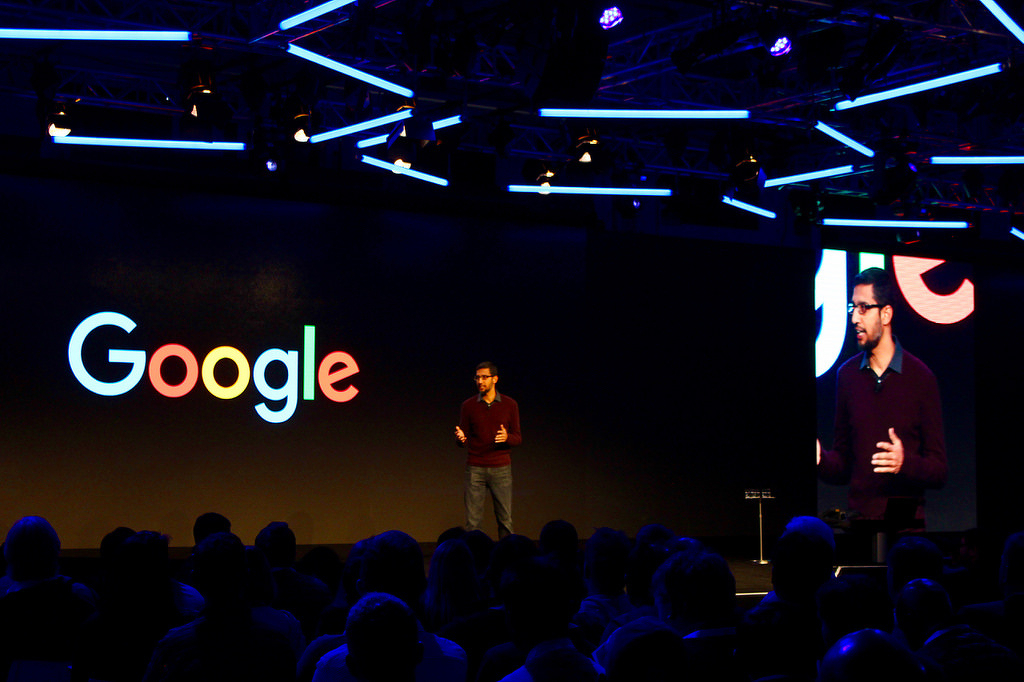 Photo by Daniel Cukier CC BY-ND 2.0[/caption]
Rumor has it that Google is set to recast itself as a full-fledged smartphone maker, with the expected introduction of its new “Pixel” phones on October 4. I think I understand what they’re up to.
To quickly catch you up, Google has for years offered up phones under the Nexus brand, but these were devices built by other manufacturers in partnership with Google, mainly intended as a “reference” for other manufacturers like Samsung, LG, HTC, and Sony, and to serve the Android die-hard fanbase. Nexus phones offered the “pure” Android experience, as opposed to the phones made by other manufacturers which usually layer manufacturer-specific alterations to “stock” Android. Nexus phones get software updates as soon as they’re available, and they are usually very well received and affordable relative to Samsung and Apple flagships.
Now it’s being reported that “Nexus” is gone, and the new name is “Pixel.” Pixel is not new, of course, being the brand under which they’ve been producing high-end Chromebooks and one (so far) Android tablet. Google reportedly intends the Pixel line of phones to not just serve as showcases for stock Android, but to assert a new level of control over the entire Android experience. The devices themselves, which will be built by HTC, will not carry any HTC branding. Not Nexus, not HTC’s Nexus, but a Pixel phone. A Google phone.
David Ruddock at Android Police has a piece today in which he ponders what the grander strategy is, and this part grabbed me:
This “Pixel versus Nexus” distinction matters a great deal. By framing the Pixel and Pixel XL as Google products and not as Android ones, and by removing all discussion of “partners,” Google will finally be able to assert that, if only implicitly, it is offering a counterpoint to Apple’s iPhones.It’s more than a name change, and more than Google simply throwing more weight around. This is part of Google’s overall effort to instill in consumers the idea that it is “Google” that they can trust to make their lives better.
Let’s back up. This past summer, Google unveiled its own take on the digital-assistant-in-your-house thing with Google Home, more or less a googly Amazon Echo. This same digital-assistant tech will also live in its upcoming messenger platform Allo, and already more or less exists in a less-personified form in Google Now on Android phones.
But what’s different about what Google does here than what Amazon or Apple does? I mean apart from whatever back-end, A.I., deep-learning, jiggery-pokery is going on in server farms. When you want to talk to the digital assistant on an iPhone, you talk to Siri. When you want to talk to the Echo, you ask Alexa. When you want something from Google, you just ask Google.
Google doesn’t want to separate itself from its interactions with you. It doesn’t want you to imagine some “character” answering your questions. Google wants you to ask Google. Google is the company and the character.
Google is also the search engine. You don’t look up information at the “Nexus Search,” you google, as in the neologistic verb. Your photos live in Google Photos, your stuff is synced on Google Drive. Google is the agent, the entity, that you look to.
But not with phones. Not now, anyway. Following digital thinking, I’m going to guess that “Pixel” is the name of the phone model. There’s the Apple iPhone, the Samsung Galaxies, the Amazon Kindle, and now the Google Pixel. Not “Google and HTC’s Pixel,” but the Google Pixel.
That means it’s an honest to goodness Google phone, just like the Pixel C is a Google tablet and the Chromebook Pixel is a Google laptop.
And perhaps most importantly, again leaning on digital piece, is that the new phones aren’t “Android phones,” any more than Apple is known for “iOS phones” or Samsung for “TouchWiz (gag) phones.” For years, the tech press discussion has been about iPhone vs. Android, but Android means a million different things in a million different contexts in a million different iterations.
Android is just the operating system, and it’s not the brand that regular consumers seek out. Almost no one other than enthusiasts go into carrier stores and ask for the latest Android phones. They might ask for the latest Samsung or Galaxy phone, but not Android. Again, no more than they ask about the latest “iOS phone.”
I frankly think Android as a brand is more or less alienating to most folks, evoking the image of something geeky and complicated. Notice that the Android device manufacturers almost never mention the word Android in their PR. They know that no one other than techies care about that. Brands like Apple, iPhone, and Galaxy give feelings of bedazzlement over cool, useful things. “Android,” I suspect, sounds like homework.
But you know what people do feel comfortable with? Google. You know what’s a nice, cute, safe word that feels both phone-related and still friendly? Pixel. Androids are semi-humanoid robots who have no feelings and might want to take over the world. Pixels are colorful things that make screens glow!
(Imagine how confused folks will get when their Google phone breaks and and they then google “how to fix dead pixel.”)
Google Home, Pixel, and all these other initiatives are of a piece. They’ve decided, I think, to stop making disparate products under disparate banners. Phones, operating systems, tablets, laptops, browsers, search engines, IOT/home devices, digital assistants – we’re meant to stop thinking of these things as separate brands in various arenas. They’re all just part of one thing, and to integrate them into your life, you just think, “OK, Google.”
If you like my work, please consider supporting it through Patreon.
Quirky: Adapting for Asperger's at the Expense of Sincerity
 Coming to terms with being a 38-year-old man with Asperger’s, having only been diagnosed a few weeks ago, has naturally lead to reexaminations of my behavior. The first things I’ve focused on have been those aspects of my personality that put me blatantly at odds with the rest of the species, such as my extreme introversion, my inability to read others’ signals or intentions, and my aversion to overstimulation.
But as some of this has begun to settle, I also find myself going a few layers deeper, and I realize just how much of my identity is wrapped up in how I’ve compensated for the hindrances of Asperger’s. Some of the more interesting exploration is not about my differences, but my adaptations – the behaviors I’ve adopted to mitigate those differences. Successful adaptations, even.
As I’ve noted before, some people have trouble accepting my Asperger’s diagnosis as a valid one, because all they see are the adaptations. They see me as someone who’s generally smart and funny and well spoken, someone who is obviously not “the average guy,” but someone a little different, just a little odd, and harmlessly so. A bit nerdy, a little geeky, and humorously self-effacing about all of it. Maybe a little too self-effacing, but oh, that’s just Paul. One of his many quirks.
That’s me. I’m quirky.
Paul says some weird things sometimes, or Paul gets oddly quiet and distant, or Paul seems to find everything funny, but also every once in a while he takes something too seriously, and talks a little too much, too fast, and too loud. But that’s just his quirkiness.
If anyone comes away with that impression of me, as “quirky,” then I have successfully adapted as best I could. Once it became clear to me, probably around my mid-teens, that I was never going to be considered “normal,” and not even in the same universe as “cool,” I decided (partly consciously, partly unconsciously) that I would adopt a quirky identity. I’d be the funny sidekick, the sarcastic friend, vaguely-artsy oddball, just minimally different enough to cover up just how utterly alien I actually felt. My quirkiness was like a white noise machine to help muffle and distract from the sound of the train line running right next to the house.
Decades of this practice led me to believe that the act was who I really was. In a new social setting, I’m harmless-quirky, making little jokes when it seems safe to do so. With bosses, I’m grinning-idiot-quirky, engaged and overly eager to agree. With closer friends, I’m wry-quirky, able to vent a little of my misanthropic steam, but in a safe and humorous way. And so on.
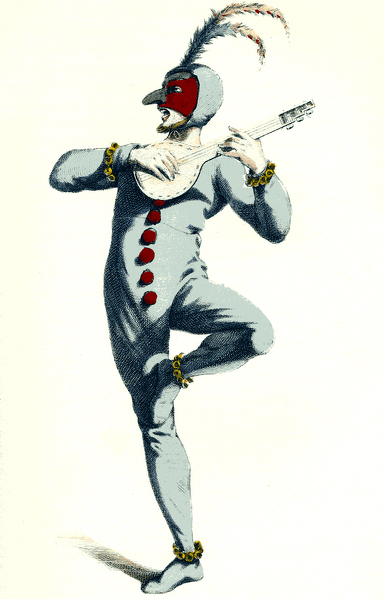
It even extends into my online persona, where the facepalming-Paul avatar has become my unofficial insignia. I have a quirky logo.
Some of it is natural, some of it is very much forced. But over the years I think I may have gotten so good at it that I don’t know when I’m “working” and when I’m just “being.”
But without this adaptive behavior, I don’t know how I would have navigated the real world. Maybe if I had known I had Asperger’s, and accepted the things that made me different, I wouldn’t have bothered to try so hard to please and to pass. What would I have been like? What happens if I decide to drop the quirk now? What will I be?
I think the scary answer to that is: sincere. I’d be sincere.
I am not an insincere person, per se, not in the way we usually think of that term. I’m not two-faced or deceptive or phony. What I mean by sincerity is a dropping of unnecessary pretenses and performances, allowing whatever person was behind those masks to come out and breathe.
That’s terrifying!
I can’t say with any exactness, but I suspect this hypothetical sincere version of me would be less expressive when in the company of others. Even in conversation, I might look distant or even severe, even if my actual feelings were entirely benign. I would interject less often, and save my words for when they might contribute to something. That might make me appear disinterested or “shy,” even if I felt neither. A more sincere version of me might excuse himself entirely earlier and more often in order to recover from the stresses of stimuli.
A sincere version of me would be less concerned with a projected personality, online and off. He would not think so much about cultivating a “brand” for himself, and simply let his work and his words speak for themselves. It would likely have no impact on the number of Twitter followers I could boast, and this version of me (again, hypothetical) wouldn’t concern himself with that anyway, because why bother.
This sincere-me would relieve himself of the stress engendered by worrying over what people thought of his various interests and obsessions. Contemporary geek culture has made the world a safe place for folks to proudly parade their allegiance to various fiction franchises, but that’s not quite what I mean, because what that really adds up to is a new in-group that happens to be made up of people who once languished in out-groups. That’s good and fine, but not what I mean.
I mean that when I have a driving obsession with something that holds no obvious value to anyone but the satisfaction of my own brain, that’s not a failing. It’s not something to be embarrassed about or ashamed of. I can just pursue that interest (within reason and feasibility) without regard to the opinions of others.
And I - I mean this hypothetically sincere version of me - wouldn’t have to make excuses for any of it. He wouldn’t have to apologize, and qualify himself with “I know this is weird” or “this probably seems silly, but…” He…I…would just follow the string of curiosity where it leads, and allow my brain its squirts of dopamine whenever they can be safely had.
The last bit of this is the hope that sincere-me would not indulge his autism and oddness at the expense of his responsibilities to those he loves. I don’t see that as a problem, because one thing that even quirky-me can be sincere about is my love and devotion to my wife and kids. I don’t need to “act” that, no“passing” required. Come to think of it, I’m very lucky for that.
The adaptations of Asperger’s have been enormously expensive in countless ways. They have eaten up time, energy, and my valuation of myself. Maybe over time, as I truly come to terms with this condition and its implications, I can begin to turn down the dials, divert power away from the quirk-generators, and recoup some of what I’ve lost. I would sincerely like that.
If you like my work, please consider supporting it through Patreon.
You Choose to Exist Here: Reliving Deep Space Nine
 Deep Space Nine has always been my favorite of all the Star Trek incarnations. Sweeping in scope, meticulous with character, and challenging my moral intuitions, I got the feeling from the entirety from Deep Space Nine that one gets from a rich and satisfying novel: I felt like a better person for having experienced it.
Occasional viewings of particular out of context episodes aside, I’ve been through the series twice. Once when it originally aired in the 90s when I was in high school and college, probably missing a view episodes due to the ephemeral nature of fixed-schedule TV airings (which seems an absurd way to watch a series now); and in the aughts when I was in my twenties, mostly via torrented downloads on my computer and old-school video iPod.
I am now beginning a third time around, in my late 30s, this time alongside my wife who, while no stranger to Star Trek, never saw DS9. We’ve just watched the pilot episode, titled “Emissary,” and there was something different about it this time, some things I truly didn’t expect.
First of all, I think I expected it to seem more dated and hokey. Instead, it came off as rather mature, far more sure of itself than most TV pilots, and head and shoulders and freakin’ torso over other Star Trek pilots. Jessica, to my surprise, said it seemed a little more mawkish than she expected, but within acceptable parameters (my words, she never talks like that). But not for me. It really held up. I rarely felt taken out of the action by something that seemed forced or overdone.
Also, I know that DS9 has the reputation of being the “downer” of the franchise, the “grim” series, but coming back to it, from the beginning, after all these years, this really was something of a shock. The original series, The Next Generation, Voyager, and Enterprise all began their runs with heaps of wonder and optimism. (Things of course go badly wrong for Voyager in order to set the stage for the series, but the hopeful “second star to the right and straight on ’til morning” spirit was always there.)
The series opens with a flashback to a massacre, and our lead protagonist unable to save his dead wife, and having to abandon his ship to a relentless zombie-cyborg force. Being stationed then at Deep Space Nine, née Terok Nor, we are placed in the midst of an ugly transition out of a brutal occupation. In the pilot episode of a Star Trek series, we are immediately faced with violent, pointless deaths and several characters absolutely spilling over with anger, regret, and helplessness. It’s quite stirring, and it all works.
But there was one part that hit me the hardest, that sunk deep into me, and oddly it’s something I’d almost entirely forgotten about from past viewings.
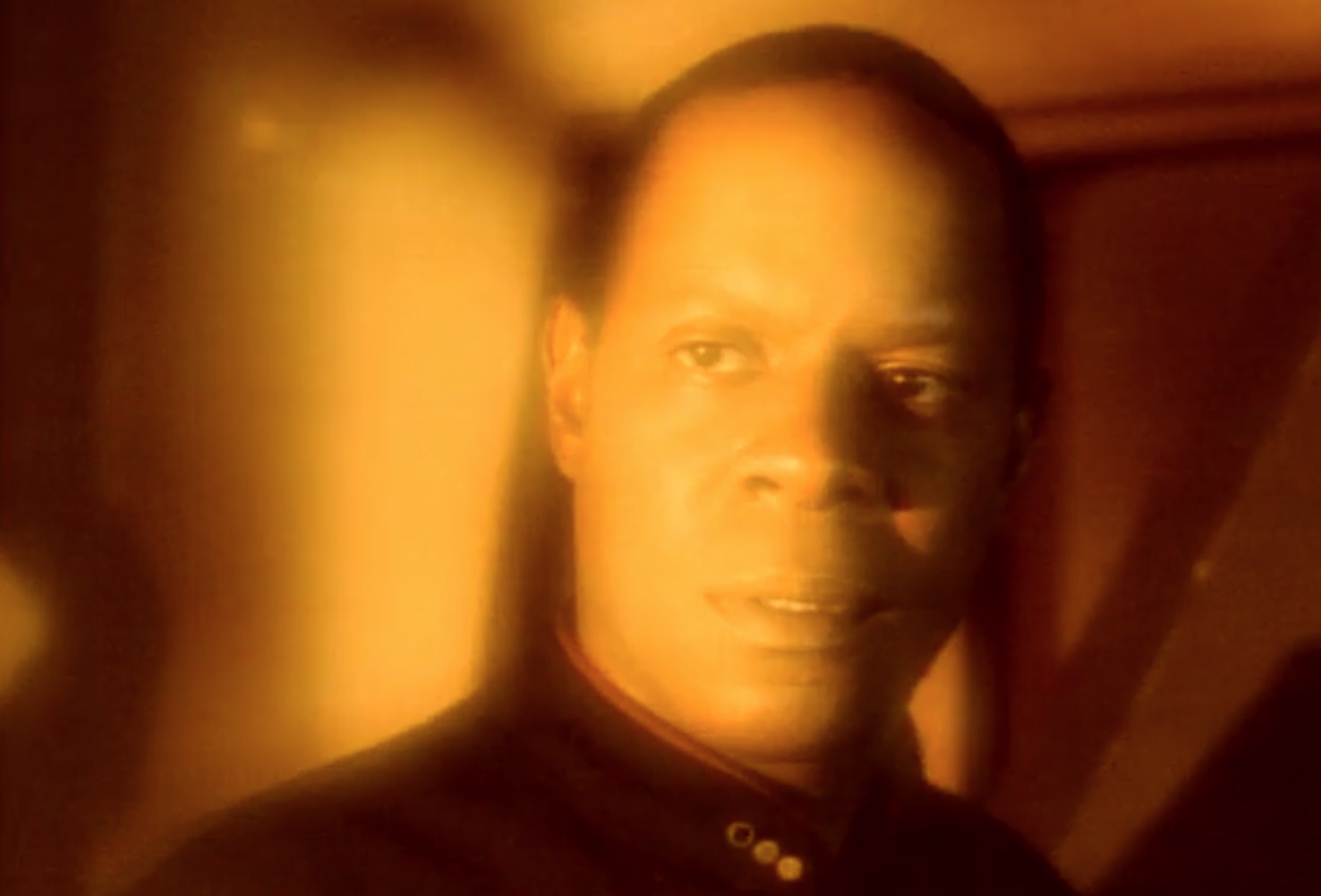
Toward the end of the episode, Ben Sisko is conversing with the skeptical wormhole aliens, non-physical entities who don’t even experience linear time as we do. They speak to him by taking the form of people in his memories, in the very settings he originally experienced them. So, for example, he discusses how humans experience time with his “son” Jake as they sit by what appears to be a lake, or with his late wife “Jennifer” as they walk down the beach where they met. It’s not really Jake and Jennifer, but wormhole aliens who have assumed their forms, taken from Sisko’s memory.
Somehow, Sisko repeatedly finds himself talking to the aliens amid his memory of the day his wife was killed by the Borg, where he sees his wife, dead, under a pile of rubble, as he’s about to be pulled away toward an escape vessel by his Bolian crewmate. Memory after memory, conversation after conversation, Sisko returns to the place and time he lost his wife.
Throughout their conversations, which are some of the headiest and evocative pieces of dialogue one was ever likely to hear on prime time commercial television, Sisko struggles to explain to the aliens how humans and other “corporeal beings” do not exist in a timeless state, but begin an existence, live their lives through a chain of causal events, and then cease to exist. The aliens are entirely unfamiliar with such an existence, and they ask increasingly probing questions in order to grasp the concept.
One thing doesn’t make sense to them. Remember, they only have Sisko’s memories as a frame of reference. Sisko is telling them that corporeal beings travel along a timeline, and make the best of their lives from one moment to the next, aware that each choice affects and allows the moments to come. And yet, they keep returning to the scene of Jennifer’s death. One of them asks Sisko, “If what you say is true, then why do you exist here?!”
It’s not the aliens taking Sisko to this scene, it’s Sisko taking them.
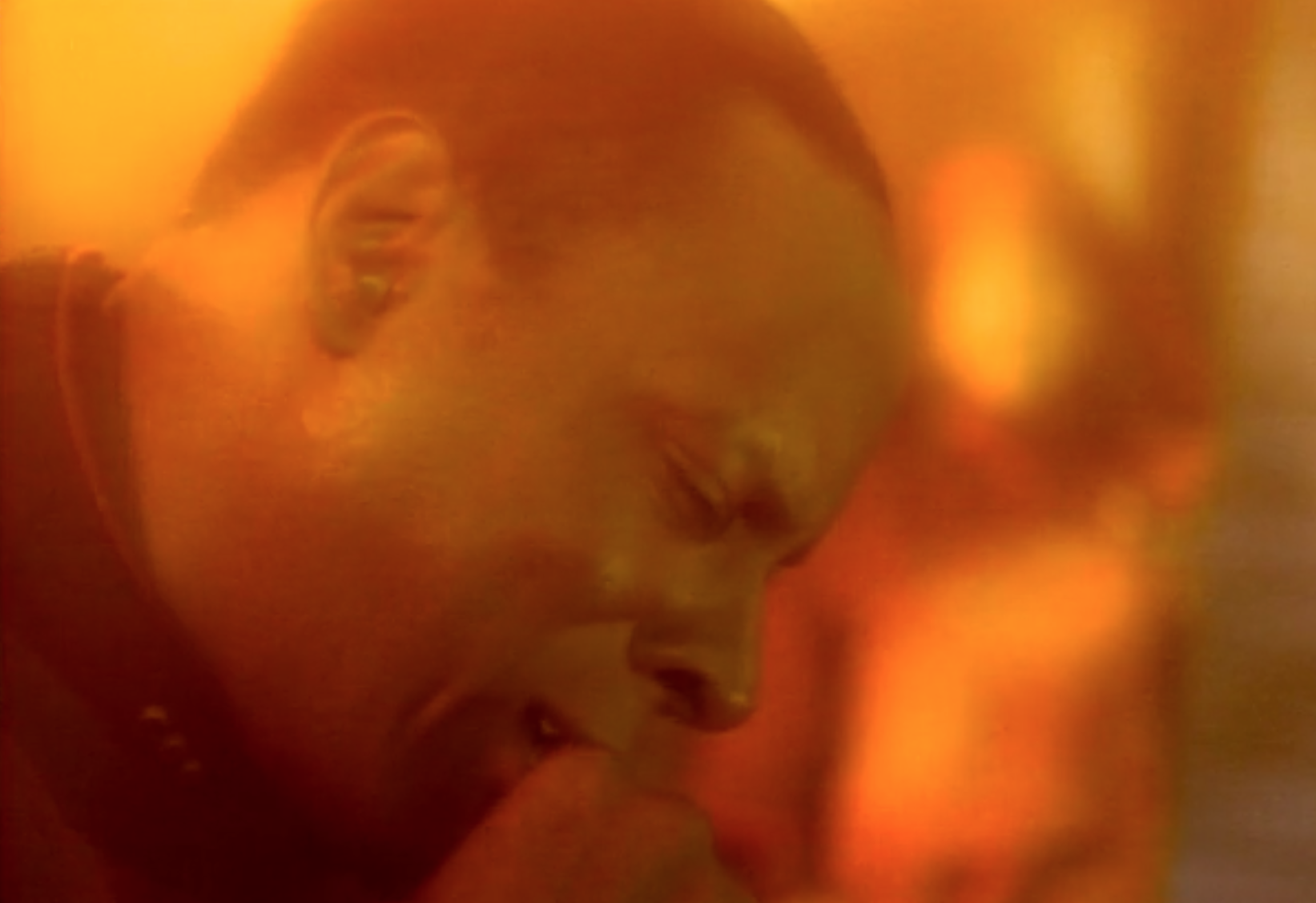 “I never left this ship,” Sisko says, a realization dawning on him.
“You exist here,” the alien in the form of Jennifer says, also beginning to understand.
“I exist here,” says Sisko. “I don’t know if you can understand.” He begins to sob, increasingly so as he speaks. “I see her like this, every time I close my eyes. In the darkness, in the blink of an eye, I see her… like this!”
“None of your past experiences helped prepare you for this consequence.”
“And I have never figured out how to live without her.”
“So, you choose to exist here,” says the alien, and Sisko nods. “It is not linear.”
“No,” he says, drained, exposed, defeated. “It’s not linear.”
In previous viewings, this scene was meaningful, but to the extent that it was a character I was interested in coming to terms with something painful. It did not truly resonate with me.
Now, as I approach 40, with a wife and two children that I love beyond measure, and with an ongoing struggle with my own post-traumatic stress, I understood.
For so long after I was attacked, I existed there, on that sidewalk, in the dark, with the sounds of footfalls running toward me, of the blows to my head and body, the impact of the concrete, the vertigo of the stumbling walk home. I existed there.
I existed in the throngs of middle school classmates joyfully mocking me, I existed in the oppressive air of the abuse and scrutiny (real and imagined) of my preteen and teenage years. Decades on, I stayed there.
And much to the sadness and frustration of those who loved me, but couldn’t understand, it was not linear.
I suppose I simply hadn’t yet lived enough to truly understand Sisko’s journey before. It’s amazing to me now, to think that this profound, climactic lesson of my favorite show just flitted away in previous viewings. I’m so glad I came back to it now to experience in earnest. I wonder what else Deep Space Nine will show me this time that it couldn’t before.
If you like my work, please consider supporting it through Patreon.
I'm Now On Patreon (And I Feel a Little Weird About It)
I am now experimenting with Patreon, the crowdfunding service, in order to see if I can ease some of my financial stress by creating meaningful units of consumable Content™. I feel a little weird about it, and I’m a little uneasy about the idea that there might be people who want to give their money to support my extracurriculars. But I already have one patron (thank you so much, Lisa Boban!), so maybe there are more who are similarly generous.
Go check out my Patreon page if you’re so inclined, and if you’re feeling really inclined, maybe pitch in. If you want. But you totally don’t have to.
Madame Defarge's Memes
 At Wired, Issie Lapowsky summarizes some research that tells us something that is not surprising, that more or less no one is ever persuaded to change their mind about a political position because of a post they saw on Facebook.
I suppose people do actually think that their social media posts are badly-needed ammunition in the political war of ideas, and that their fierce, impassioned, and ironclad arguments will surely win over the misguided. I assume they really do think that. Intellectually.
But the truth, which I believe they at least feel at a gut level, is that these political social media posts are social tokens, signifiers of belonging to a particular group, earning good will and social capital by reaffirming that which they all already believe. That’s largely why I write political tweets, usually because I think I can do so in a funny way and get some positive validation that might begin to fill the abyss that is my self-esteem. My zinger about Trump or my spirited defense of Hillary isn’t going to move the needle one teeny tiny little bit in anyone’s mind, and I have no expectation that it will.
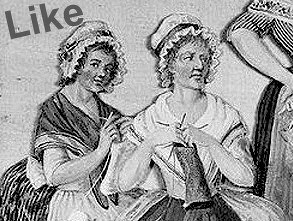
At this level it’s harmless (other than those perilous moments when my tweets are not affirmed and I fail to achieve validation). The problem arises when the posts and tweets and memes go from social tokens to something more like Madame Defarge’s knitting. Outside of the more black-and-white world of election-year D vs. R posts, social media posts involving politics and heated social issues are designed to affirm via othering, by striking clear delineations between the good people and everyone else who is irredeemably bad for failing to check every ideological box, whether they know those boxes exist or not.
And it’s not just reactions to one’s own posts that do this work. It’s the posts of others. Lapowsky writes:
The majority of both Republicans and Democrats say they judge their friends based on what they write on social media about politics. What’s more, 12 percent of Republicans, 18 percent of Democrats, and 9 percent of independents who responded say they’ve unfriended someone because of those posts.So it’s not political persuasion, as we might like to believe, it’s shaking the trees for villains to fall out of, it’s political partitioning.
In the film Bananas, the Castro-like ruler Esposito delivers his first speech to his people, and tells them, “All citizens will be required to change their underwear every half-hour. Underwear will be worn on the outside so we can check.”
The kind of social media I’m talking about is that underwear you just changed, and you’re pretty damned proud that you did it after only 29 minutes.
Asperger's, Corrective Lenses, and the True Self
What does it mean to “be yourself”? I think it means to behave as you would if you were more or less unconcerned with how others perceived your behavior, and I assume it’s implied that this being-yourself behavior is largely within the bounds of the law and socially acceptable norms.
My recent diagnosis of Asperger’s syndrome has opened up the opportunity for me to let go of my self-doubt and self-mortification, and to begin to embrace my Aspie nature, within reason, without concern for how it plays. It sounds pretty exciting! A lifetime of anguish can now be discarded, and real liberation experienced! I can be myself! I can be the real me!
The problem, however, is that I’m not sure what the real me actually is. I’ve never really experienced the unfettered, unthreatened real me. Depending on the circumstance and either my comfort level or lack of inhibition, I presume have let varying degrees of “real me” emerge, be it in small drabs or convulsions of impulsivity that I have almost always regretted. But to put down all of the armor, to remove the masks, and to deactivate the constant self-surveillance, I do not know what that is. I don’t know who that is.
I mean, it’s “me,” right? But “me” is also the sum of my experiences plus the “real me” of genetics and biology. By that way of thinking, the self-loathing and self-censoring mini-golem I have been all my life is the real me.
However, now I know about my condition. I know that my brain was wired differently at birth through no fault of my own (or anyone else’s). So this new knowledge is now one of those experiences, it’s a new piece of “real me.”
Which I guess brings us back to where we were. So maybe the question is, what is the real me now?
One way to answer that might have to start with a different question: What would I like to be the real me now?
When the prospect of being prescribed things like anti-anxiety and anti-depressive medication first came into my life, I was very reticent. I was hung up on the fact that what makes me who I am is my brain, just the way it is. While taking certain medications might make me feel better in certain ways, and make life more manageable, I feared that the medication would fundamentally change who I was, by tinkering with the chemistry of my very Self.
But what I came to accept and appreciate is that if we’re lucky, life, being ridiculously short, offers us the chance to augment or repair aspects of our existence that hinder our well-being. I wear glasses to correct my vision, and I don’t consider blurry vision to be a key aspect of my true self. Having corrected vision absolutely impacts how I perceive and interact with the world, with countless internal and external implications. It’s a small thing, to wear glasses, but its effects are life-altering. But I don’t feel I’m being untrue to myself to wear them. If anything, I now consider them a part of my identity. I have adopted them into my “self,” so that “real me” is, among other things, a guy who wears glasses.
And so I decided it could be for pills to make me less sad and less scared. The real me would now be a guy (with glasses) who takes pills to make himself less scared and sad. That feels okay.
Today, I’m a guy who’s just found out he’s autistic at the age of 38. I didn’t have the benefit of this knowledge growing up, so I assumed I was faulty and subhuman, sent into this breathing world scarce half made up.
Cynthia Kim of Musings of an Aspie wrote something about self-acceptance that echoed my own experience, to a point:
When you grow up knowing that you’re different – and worse, suspecting that you’re defective – acceptance doesn’t come naturally. Too often, autistic individuals are acutely aware of the ways in which they don’t measure up to social norms. As a child, I knew that I wasn’t like most of the other kids and in the absence of an explanation, I assumed that I was simply doing something wrong.I hoped for immense joy, but it hasn’t come yet. When the diagnosis was confirmed, there was no light from the heavens that lit up my soul and freed me from my past. A burden was lifted, surely, but a different one was placed on me, one that sounded more or less like “now what?”Finally having an explanation for my differences forced me to challenge some long-held beliefs about myself. What if all these things that are wrong with me – I was still thinking more in terms of “wrong” than “different” – aren’t my fault?
Those first inklings of acceptance brought me immense joy. Decades of thinking I just wasn’t trying hard enough were cast in a new light. I wasn’t defective; my brain worked differently.
To be sure, self-forgiveness is coming. I now know why I didn’t “measure up to social norms,” when “be yourself” was simply not an option. And that’s very welcome. But what’s not clear yet is how to move forward.
Here’s what I do know. I want to drop the armor and masks in a pile, and walk away from them forever. I want to shut off that self-surveillance system that’s been running inside me since I can remember, and disconnect the power supply.
But I also want to know which of my Aspie quirks and predilections can be fully embraced, which I have to regulate, and which I have to bury. I know I can’t let go of all control and turn into some hyper-misanthropic live wire. I have responsibilities, and I have people I care about who need me to regulate. Who need me to put my Asperger’s traits aside as best I can, at least sometimes.
So it seems what I need to do is to start examining all these pieces one by one, and experimenting with what works and what doesn’t, which aspects of the “real me” I can run with, and which ones need to adjusted or worked against. I’ll need to discover how they work in different combinations with each other, and in what contexts. I’ll need to decide which ones I actually like, and which ones I want to curtail because of some unhappiness they might bring.
What eventually becomes the “real me,” then, will take time to emerge, and be at least in large part of my own making. I’ll be a guy with glasses, who takes pills to keep from getting to sad or scared, whose brain is wired to have some real big problems with the world around him, who also has some gifts to take advantage of, and who found out at 38 that he has Asperger’s syndrome. Somewhere, in all that, I hope I can find a real me.
And I hope that eventually I can, for the first time in my life, be myself.
The Plausibility Threshold
I’m not at all opposed to the idea of allowing third party candidates into the general election presidential debates. In most cases, of course, there’s little reason to, as even the exposure and legitimization it would give to said third party candidates would almost never result in one of them becoming seriously competitive for the presidency. (Ross Perot in 1992 was legitimately competitive, so he definitely belonged in those debates. In 1996, there was no real chance for him, and being on the debate stage wouldn’t have changed that.)
A great shame of our electoral system as it currently exists is that there is no mechanism for expressing preference for a third party in a way that doesn’t result in self-sabotage. It’s a first-past-the-post plurality game, so a vote for liberal-third-party-candidate X means one less vote for less-liberal-but-actually-viable-Democrat Y. Without something like instant runoff voting, the whole discussion is more or less moot.
But let’s pretend for the sake of argument, though, that our system is set up to make it reasonable to vote for third parties, and that there ought to be a relatively low threshold for getting into these debates. Let’s say, again for the sake of argument, that instead of the current 15 percent in polls, it’s something like 5. That would have probably gotten Ralph Nader on the stage in 2000, and in this election, it would easily qualify both Gary Johnson and Jill Stein.
But even granting all of this in our imaginary scenario, something still doesn’t sit right with me about it, and I think I know what it is.
To fully understand my thinking, you have to temporarily forget that the Republicans nominated a lunatic huckster this time around. Donald Trump’s presence in the equation clouds the air of gravity for the presidential debates, so it might help to replace him in your mind with someone like Mitt Romney or John McCain. So do that now. On this imaginary debate stage, with Martha Raddatz or Bob Schieffer or whoever moderating, you have some Romney-McCain type, former Secretary of State and Senator Hillary Clinton, and…Gary Johnson and Jill Stein.
Since winning isn’t in the cards for Johnson or Stein, regardless of the electoral system in place, the ostensible benefits of their participation in the debates would be 1) to have someone articulate positions and concerns not expressed by the major party candidates, and 2) to lend new legitimacy to, and build up the viability of, the third parties for future elections, sending the message that, yes, candidates from these parties are and will be serious options for the presidency.
But is Gary Johnson really presidential material? Really? He seems by all accounts to be a good, principled man with good intentions, and he was a governor, but still. He doesn’t seem to have thought through all of his positions, he has trouble answering questions in succinct sentences, and he hasn’t held an office since a year before Facebook even existed. In my opinion, he doesn’t quite present the figure of a plausible president, and the irony is that he’s the closest the Libertarian Party has ever come to offering up someone who does. He’s more of a “this is the best we could do” candidate for a struggling minor party.
And even presuming the best about Jill Stein (which is a major challenge for me), despite her admirable activist background, she has never won elective office (save for a “Town Meeting Seat” in Lexington, Massachusetts), she panders to conspiracy theorists and paranoiacs, and deifies people like Julian Assange. She is definitely not a plausible president.
And that’s so dispiriting. As someone who’s worked professionally for systemic solutions that would clear the way for third party candidacies, I would love to see a more vibrant and dynamic set of views represented in these debates, but that also means I want those views articulated by credible candidates. Plausible presidents.
This year, the Republican Party has decided not to put forth a plausible candidate. In my imaginary scenario, we had a veteran officeholder of real gravitas to stand for the GOP, but in reality, we have a dangerous man-child. So it’s easier to look to the third party candidates and think, well, shit’s already crazy, why not let them in too? And I get that. But it’s also true that he could actually win, unlike the other two minor candidates, so he needs to be confronted by his billion-times-more-qualified opponent in front of the nation.
But for the third parties, in the abstract, I don’t think debate inclusion achieves what these parties hope they might, and what they really need them to achieve: to show the American public that their zone of the political spectrum can offer up real presidents too. The Libertarians are almost there with Johnson, and frankly would be there now if they’d flipped the ticket and nominated VP candidate Bill Weld instead, or recruited some titan of Silicon Valley like Meg Whitman, Larry Page, or Sheryl Sandberg. The Greens are nowhere near plausibility right now, with Nader 16 years ago being by far the closest they’d ever come to putting forth a credible would-be president. I honestly can’t think of anyone today who might jibe with their politics and be a plausible president, save for perhaps Bernie Sanders.
I want to see that debate, with three, four, or more honest-to-goodness potential presidents advocating and arguing their cases. But our electoral system makes it pointless, and the candidates we’ve gotten so far from the third parties makes it doubly so.
A More Forgiving Lens
I have never felt like I belonged in this species. I resembled a human, and I could force myself to awkwardly ape the basic mannerisms of people, but I would always suspect that there was something alien about me, and that everyone else suspected (or knew) the same thing.
A lot of this alienation is in regard to my relationship to, and interactions with, other people. I’m a pretty severe introvert, that’s no secret. Being around people, even those I love and feel most comfortable with, utterly exhausts me. But I’ve always felt that there was more to it than mere introversion. For as long as I can remember, I’ve struggled to relate to almost anyone, unable to comprehend others’ values, aspirations, needs, obsessions, or subtexts.
As a result, I’ve been at a loss as to how to blend, to appear as though I do understand, or at the very least to keep my bewilderment hidden. So I’ve thrown an inordinate amount of processing power at figuring out how to appear normal, how to talk, stand, sit, move, gesture, and where to fix my gaze or how to modulate my voice. I pretend to value the same things other people value and aspire to the same kinds of things they aspire to, even to the point of almost entirely convincing myself.
That alienation, this constant dissonance, was of my own making, I believed. I didn’t share the same interests as others because I had somehow failed to grasp the obvious reasons they were important or provided joy. I didn’t engage in sports or other physical activities because I was weak and afraid and unwilling to put the time in to not be that way. I had trouble comprehending instructions and directions because I was being self-absorbed and inattentive. I had trouble reading for any length of time because I was superficial and distracted. I upset people I love, not giving them what they needed, because I was negligent, self-centered, and oblivious. I didn’t want to socialize because I was a stick in the mud, narcissistic, and timid. I didn’t want to go on big adventures, travel, take big risks, or throw myself into new situations because I was cowardly and lazy. That summed up why I fared so poorly, academically and socially, throughout much of middle and high school: I was cowardly and lazy.
What else could I conclude? And having reached such a conclusion, over and over, in every circumstance from childhood to my late 30s, brought self-hate, depression, anxiety, resentment, and resignation. How could it be any other way?
I did have one suspicion, though. A suspicion that kept popping into my awareness, something that felt familiar, but also sounded too alien even for me.
That suspicion only grew, however. When I would air it out loud to someone, it would be summarily dismissed. I, not trusting my own perceptions of the world, not knowing how to be a person, conceded to the dismissal. But only outwardly.
I stopped conceding. I have finally pursued this suspicion to its end, and, well, it turns out for once I was right.
Last week, at the age of 38, I was officially diagnosed with Asperger’s Syndrome, a form of Autism Spectrum Disorder, along with Attention Deficit Hyperactivity Disorder.
I have Asperger’s. I am autistic.
I’m so very glad to know. And I’m also glad that there was no hedging on the part of the doctor, the neuropsychologist who tested and diagnosed me. As my wife Jessica and I sat down in her office, the doctor mercifully began by saying, “I’ll cut to the chase, because I know you’re eager to know,” and told me that I had what she characterized as “severe” Asperger’s syndrome. Not severe in the sense of debilitation or in some kind of danger, but meaning that I’m firmly, well into the spectrum. Had the diagnosis been fuzzy, a borderline case, I’d never stop wondering and doubting. Having it be so clear-cut was a relief.
When I first began toying with the idea of getting tested, I couldn’t avoid the fact that simply knowing I had Asperger’s, if indeed I did, wouldn’t really change anything. There’s no medication to take, there’s no real treatment. I’d just go on as I had been. I had to ask myself, well, why bother?
Here’s why. The dissonance of my life – my strange predilections, my quirks, my strong and irrational aversions, my inability to read or connect with other people, my lack of interest in the experiences of life, my intractable obsessions over particular topics and utter lack of curiosity for almost anything else, my desperate need for safe and reliable routines, my spacial disorientation, my hypersensitivity to heat, sound, and light, my clumsiness and lack of coordination, my over-reliance on rules and logic, my inability to think in broad, big-picture terms, and most especially, the panic, pain, and exhaustion I experience in even the most benign social situations – I have always ascribed these things to my being a failure as a person. A lazy, cold-hearted, short-sighted coward.
Now I know that much of it (not all, of course) stems from something I was just born with. There was an actual condition that made it impossible that I could ever be and think like everyone else. My brain was literally different from theirs, and there was nothing I could have done about it.
Generosity of spirit is one of the virtues I value most, but it is never something I allowed for myself. Instead, I have tortured myself over my past, for the things I endured and the things I felt I had brought upon myself, because I had failed at some point to become fully human. I blamed myself for having neglected to learn how to be a normal person. I wasn’t just unable to cut myself a little slack for the failures and disappointments of the past, I had forbade myself from doing so. To forgive myself, I felt, would be to allow myself to continue to fail and disappoint.
Now I can reevaluate. I can look back on the story of my life through a more forgiving lens. I honestly don’t know what that might do to me.
As I sit here now and tell myself this is real, it’s hard to accept, even though it’s mostly welcome. I obviously have a great deal more processing to do. Some of that processing I’ll do here, in writing, as it seems to be the way I best understand and express my thoughts. In writing, the rules and parameters, and there are no social cues to miss or misinterpret, no eyes with which to avoid contact, no expected time frame in which to form and verbally express a thought, no expectation that I intuit the nuance and give-and-take of a real-time conversation. Here, I don’t have to second-guess my very worth as a human being.
Actually, maybe that’s the first thing I should do: Accept, finally, that there is nothing to second-guess, and that I don’t have to pretend to be normal anymore. Maybe I never did.
If you like my work, please consider supporting me.
The DNC Doesn't Owe You Anything
I just want to expand upon a point I made snarkily on Twitter that’s gotten some attention and heat. I said:
BREAKING: Secret emails reveal that many in DNC did not like non-Democrat, anti-DNC candidate Sanders, preferred actual Democrat.WikiLeaks (which probably needs a whole other post to complain about) released private email correspondences from the Democratic National Committee showing that, shock of shocks, the DNC really did favor Hillary Clinton over Bernie Sanders.
Well no shit.
There is nothing wrong with a political party’s operation preferring one candidate over another, especially if one candidate would be a terrible choice for nominee. Especially if that terrible choice also happens to have been a Democrat for about five minutes. Especially when that terrible choice seems to loathe the very party he wants to nominate him.
The DNC would be full of suicidal lunatics if they didn’t prefer one over the other when the choice is so stark. If it were a choice between, for example, John Kerry and Joe Biden, there would be little reason for there to be any kind of consternation over who might get nominated. Neither of those candidates oppose the party itself in any meaningful way, and both would have comparable electoral prospects. But Clinton versus Sanders is easy. If you are in the DNC, and you’re not a lunatic, you prefer the former Secretary of State and First Lady who’s mind-blowingly qualified and has been fighting for and winning Democratic objectives for decades. You don’t choose the batty old socialist from Vermont who has accomplished little in office, who has accused the party of all manner of crimes and corruption, and who isn’t even really a Democrat to begin with. Because, again, we’re assuming they’re not lunatics.
Ah, you might retort, as many have in various forms, So it’s okay that the party cheated and denied the voters their true choice???
Stop it, I say, you sound crazy.
First, there’s no reason to believe anyone cheated anything, and asserting as much is just conspiracy mongering. And there would have been no reason to “cheat” anyway, because Clinton — at all times throughout this entire campaign, without any exception of which I am aware — was the more popular candidate. Thus, she won the most votes, and also thus, won the most pledged delegates. So the voters actually got their choice. Just because you might not like that choice doesn’t mean it isn’t true.
Second (and I feel like I’m beating this drum to death), political parties are not the government, and they have no obligation to choose the candidates they field for office by election. None. The DNC doesn’t owe you an election, or a voice, or any role in its nomination process whatsoever – especially if you’re not even a Democrat. They’ve chosen to go about it a certain way that includes a mix of statewide popular elections and the judgment of some party leaders. But any political party could decide tomorrow that they will choose candidates by random lottery, by a series of duels, by high score at Crossy Road, or — and I know this sounds nuts — by a bunch of party leaders getting together to hash out which candidate would best advance the causes of the party and have the best chance of getting elected. Insane, right?
This is to say that if the DNC did put their thumb on the scale for Clinton somewhere, that’s entirely within their right to do so. But it’s also true that there’s little evidence that they did any meaningful thumbing. The scheduling of the early debates on Saturday nights was stupid and transparent, and actually kind of cowardly, but it wasn’t evil or undemocratic or anything like that.
The DNC’s obligation is to further the Democratic Party. That’s what they owe you, the best shot for Democrats to be elected to office. They are not obligated to appease a loud and hostile constituency, or even to honor small-D democratic principles. They need to help Democrats who believe in Democrat things get elected. That’s it.
My only wish is that they were better at it.
I Watched the Mighty Skyline Fall
Cleaning up the kitchen after dinner this evening, my wife Jessica had put on some Billy Joel to listen to, and asked what album of his I preferred to hear. Songs in the Attic, I replied, his 1981 live album intended as a way to introduce his older songs to an audience who has just become aware of him from 1977’s The Stranger. The performances of songs like “Streetlife Serenader,” “Los Angelenos,” and “Summer, Highland Falls” are far, far superior to their studio album versions. Perhaps my favorite song on the record, however, is “Miami 2017 (Seen the Lights Go Out on Broadway).”
[youtube www.youtube.com/watch
And then it hit me. Holy shit, I thought to myself. It’s 2016. Next year is 2017. That’s crazy!
Let me just quote Wikipedia for an explanation of what this amazing song is all about:
Joel has described it as a "science fiction song" about an apocalypse occurring in New York as a result of discussions that the city was failing in the 1970s. … He explain[ed] that the song depicts the apocalypse occurring in New York, "the skyline tumbling down, this horrendous conflagration happening in New York City." Joel stated that the song is titled "Miami 2017" because many New Yorkers retire to Miami and the narrator is telling his grandchildren in the year 2017 about what he saw in the destruction of New York.So in Joel’s sort of alternate-parallel-universe, New York City becomes an unfathomable disaster (“it always burned up there before”), its problems in the 70s running out of control, and some unmentioned authority sees to it that the city is simply wiped off the map. (“They said that Queens could stay,” of course, and someone “picked the Yankees up for free.”)
I assume that this urban apocalypse happens more or less contemporaneously with the time the song was written, the late 1970s, because in the song, 2017 is supposed to be the far future, when elderly retirees in Miami are thinking back on the event, “Before we all lived here in Florida / Before the Mafia took over Mexico.” But of course 2017 is no longer the far future. It’s five and a half months away.
It’s worth pausing to consider, as noted by Joel himself, that on September 11, 2001, we all, in fact, “watched the mighty skyline fall.” But it wasn’t a failed city that needed to be “dealt with,” as in the song, but a revived and ascendant city that was attacked by those who preferred that we all exist in a kind of Bronze Age hellscape.
But in both cases - the obliteration of the city in the song, as well as after the towers fell in real life - New Yorkers are and were defiant and resilient:
We held a concert out in Brooklyn, To watch the Island Bridges blow. They turned our power down, And drove us underground, But we went right with the show!Luckily, in the real world, New York is still here as 2017 approaches. But there’s also the eerie line in the song about how “the Mafia took over Mexico.” That, of course, hasn’t happened as far as I know. But the intractability and unthinkable horrors wrought by drug cartels in Mexico today make the line disturbingly prophetic.
I wonder if Joel could have conceived in his dystopian 2017 that someone like Donald Trump might approach the presidency. After a year like 2016, it’s not hard to imagine a President Trump, fictional or nonfictional, deciding that the best way to deal with any hotbed of trouble and unrest, be it within or without our borders, is to lay waste to it.
In which case, we’d be looking back on it from, say, 2057. Not in Miami, of course, because by that time it’d probably be either under water or too hot to bear. But perhaps in Maine, forty years from now, a handful of us old folks will look back in horror and wonder, still alive, “To tell the world about / The way the lights went out.”
But of course, it’s just a song.