newsletter
The Big Thing
About a year ago, I announced my intention to complete a major writing project that I had begun, and subsequently abandoned, two and a half years before. Publicly declaring my intention to finish this piece, “The Big Thing,” was a way to hold myself accountable. I was generously granted two weeks at a writers’ retreat and the necessary time off work to bring this project into being, and my failure to actually make something out of it, no matter how well justified, was a stain on my sense of self that all great Neptune's ocean could not wash clean.
And besides, it was about stuff that’s really important to me.
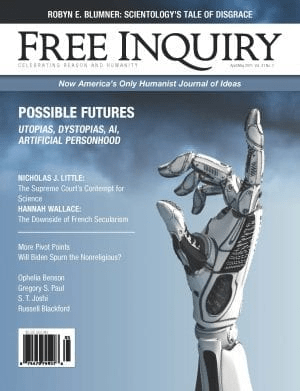
Long story short, I buckled down and finished the damn thing, and it’s now the cover story for the April-May 2021 issue of Free Inquiry magazine. It’s 11,300 words-and-change comparing and weighing two views of humanity’s future: transhumanism (we’ll all be saved and improved by technology) and “collapsitarianism” (we’ve blown it and civilization will crumble).
Why these two? Because I feel pulled toward both so strongly, despite their disparate outlooks. It’s the longest piece ever published by Free Inquiry (for which I am immensely grateful) and its editor, Tom Flynn, says it “just might be one of the most profound” (for which I am immensely humbled).
In this post, I offer an excerpt from the main article, its opening “chapter,” as it were. I do ask that you’ll take some time and read the whole thing. It’s been made free to non-subscribers of Free Inquiry, so you are welcome to simply click over, read it in your browser, or add it to whatever read-it-later service you prefer (but please do actually read it later, don’t let it just be another link you totally intend to get to someday).
It begins like this:
Not too long ago, humans believed that the stars determined their fate. Some still do. It was a belief born of naïveté, misunderstanding the nature of those diamonds in the night sky. But it was also a sign of our hubris, to presume that those lights in the firmament could have any interest in us.
Rather than feel controlled by them, we now understand that the stars are not gods or arbiters of fate but places we now aspire to explore. The knowledge of what stars actually are, and how insignificant we are in comparison to the vastness of the cosmos, has humbled us. And yet we are brash enough to speculate that one day we will be determining the destinies of stars, not the other way around.
Today it’s pretty hard to see those stars. Pollution from smog and the spillage of light from our cities obscures our view of the heavens. The haze through which we must squint to glimpse the constellations reminds us, or reminds me anyway, that humanity’s upward trajectory is not a destiny but a story. A wish.
I am torn. I am stubbornly attached to the idea that one day we’ll all be living on starships, exploring the cosmos free of hunger, disease, poverty, and tribalistic conflict. Looking around at the pace of technological advances today, it still feels possible. I want it to be true.
But one only has to consider the speed and breadth of humanity’s destructiveness to have those dreams thoroughly dashed. Whether we look to the exhausted vitality of the natural world or the buckling integrity of our modern, enlightened societies, we can no longer deny the obvious. The world we made is crumbling.
I dread a global, systemic collapse for my own selfish reasons, of course. As much as I sometimes crave the solace and remoteness of a more rustic, pastoral life, I know that when the shit hits the fan, I’ll be one of the first to die of starvation or disease or be murdered by wandering marauders. I’m very much attached to, and a person of, the current age.
I dread it for my children even more. While they’re growing up faster than I can replace their socks, I can’t quite escape the guilt I feel for even bringing them into being when things are so dicey for the civilization they will have to make their way in. I desperately want them to thrive, not merely struggle to survive in a world their parents couldn’t keep.
Vacillating between hope and despair, I have somewhat paradoxically found myself captivated by two starkly divergent lines of thought, two seemingly opposing prophecies about the fate of humanity that at different times have seemed to me equally persuasive. One camp posits that human civilization is ripe for collapse and that industry, governments, society, and much of the ecology that sustains us will soon run aground, leaving the remainder of our species to cope with a blighted aftermath. The other proposes that despite the enormous challenges before us, human ingenuity will find solutions through technology and biological enhancement, defeating not just climate change but perhaps even death itself. I deeply yearn for the latter to be true. I am anguished that the former is much more likely.
In a more hopeful time, I was drawn to the optimism of transhumanism, the PhD-riddled intellectual movement that once excited my Star Trek–saturated imagination with its often-rapturous predictions of a humanity augmented with unimaginably sophisticated technology.
More recently, however, I have leaned away from utopian thoughts and into a palpable despondency. I have since recognized this feeling for what it is: grief. I am grieving for the world I once believed existed and the future I know never will.
Just as I was beginning to acknowledge this grief, I discovered a movement known as Dark Mountain. Not a formal association or ideology, Dark Mountain is a sort of cultural banner under which those who await the fall can gather. For me, it has served as a way to process what has become increasingly obvious: collapse is coming.
And yet, all the while I have been holding onto the wish that we are mourning prematurely and that there is still something better coming.
We might very well be capable of transcending our biological and corporeal limits and achieving wonders not yet dreamed of. Or we might soon be forced to reckon with all we have wrought upon this world and then struggle to find some way to atone and survive.
Transhumanist utopianism and collapsitarian despair. They may appear fundamentally at odds, but I think what attracts me to them both is their implications of inevitability. Both presume their vision of the future is inescapable, and their adherents suggest we not waste energy fighting that future; we should instead start preparing ourselves for it. It is the overlap of “the end is nigh” and “resistance is futile.”
What I need right now is clarity. I need an honest appraisal of where we are and where we are headed. Maybe you need it too. Are we doomed? If so, let’s face that hard truth and decide what to do from there. Are we going to save ourselves? If so, how will we do it and at what cost?
In either case, collapse or transcendence, who and what will we be when we come out on the other side? To answer that, we probably have to figure out who we are right now.
This is about more than trying to guess how things will look a century from now. This is about what it means to be human and deciding whether that, in itself, matters at all.
Read the whole thing right here. And thanks.
I have a newsletter, and you should subscribe to it.
Who cares what I think?
This is from the tenth edition of the Near-Earth Object newsletter, to which you can and should subscribe, right here.
I thought it was about time I gave myself permission to write about things that weren't all that important.
We're living through such Unprecedented Times when so many Serious Things are happening every hour, I think I started to feel like it would be irresponsible to write about things that were not directly related to the end of the republic or the plague.
But honestly, who cares what I think?
I don't mean that in a self-deprecating way. Okay, yes I do, but I also mean to say that plenty of other smart and good-hearted folks already have this covered. There are times when I do feel like my particular perspective on current events is valuable. But, you know, not all the time.
And at the same time, I have a lot of big thoughts about things that simply aren't existentially consequential. Lately, though, I guess I've felt like it would be almost inappropriate to talk about anything frivolous, like superhero TV shows or gadgets, let's say. Since no one is currently paying me to publish my thoughts on unimportant things (oh please someone pay me to do that), it sort of felt rude to do so—almost gauche.
But that's stupid.
So within the past couple of weeks, I wrote a two-verse sonnet to capture my reaction to the 2016 pilot episode of the show DC's Legends of Tomorrow. Read it, even if you don't know what I'm talking about.
I wrote about how cool it is that when I needed my iPad to serve as my primary personal computer, it unexpectedly filled that role really damn well. Read that too!
I also posted some fake news! Let me explain. I am experimenting with coming up with fictional news articles, not satire per se, like The Onion, but just things that aren't true. Maybe it's funny, maybe it's not.
I don't really know why I'm doing that, but the idea was inspired by a piece in Current Affairs by Nathan J. Robinson, "The Truth Is Paywalled But The Lies Are Free." My fake articles fall are published in a fake publication I call Free Lies.
There's one about "sad potatoes."
There's another about the government adjusting gravity.
Maybe I'll make more of these. Who can say?
Who cares what I think?
As always, if you find this stuff valuable, you can toss some currency my way. It’s totally okay if you don’t!
Measured by how we are seen
This is from the eighth edition of the Near-Earth Object newsletter, to which you can and should subscribe, right here.
This project of producing newsletters and media at a somewhat regular clip, is still new to me, and I'm still trying to find the right mix of elements that make it really click. For my first video-cast-pod-thing, I chose to read a piece I'd written a couple of years back about how hard it is to put in the time, effort, and emotion into all this creative work, all the while knowing that it will reach only a handful of people. Of course one can't know this for certain, but it's a solid bet!
I think the cold reality of irrelevance has hit me a little harder this week, as the election receded from the top of my mind and I took a little time off work. When a room opened up in my brain, it was quickly furnished with feelings of futility.
I began reading How to Disappear by Akiko Busch this past week, and in the introduction she says, "It has become routine to assume that the rewards of life are public and that our lives can be measured by how we are seen rather than what we do." As someone who grew up being utterly ostracized for how he was seen, and then later became a professional actor, and then later got into nonprofit communications, I think I've been conditioned to measure my value by how I am seen. I'm not sure I'd know any other way.
We're all feeling fragile right now. The slow-moving coup in process makes it feel like we're watching an asteroid that's going to slam into us in a couple of months, and all we can do is watch it get imperceptibly closer day after day. The foundational things we've relied on to tell us who we are as a people look like they're about to crumble. If they do, we won't know who we are anymore. If they don't, we'll still know that we aren't quite what we thought we were. We're all facing an identity crisis.
So maybe none of us can settle our minds enough to find meaning within (or nearby) rather than without.
In my favorite novel, Neal Stephenson's Anathem, the protagonist Erasmas, a sort of monk-scholar in training, is given an urgent bit of wisdom from his mentor, Orolo.
“That is the kind of beauty I was trying to get you to see,” Orolo told me. “Nothing is more important than that you see and love the beauty that is right in front of you, or else you will have no defense against the ugliness that will hem you in and come at you in so many ways.”
Maybe if our identities weren't so wrapped up in these performative digital spaces, we'd be handling things better right now. Maybe if I were better able to see myself as enough, if I were able to love the beauty that is right in front of me, perhaps I could more thoroughly cast out the ugliness in my head that tells me I am not and never will be enough.
But if I do that, then what will I be?
If you're reading this, I'm so glad you're here. You are part of a small group, and I appreciate each and every one of you.
More of Paul’s irrelevant-yet-immeasurably-valuable stuff
New post on how news sites’ homepages are covering the coup: “Homepage Hopping at the End of Democracy.”
New video-cast-pod on Biden the caretaker, with some post-election thoughts as an addendum:
[youtu.be/FiQUY8iUp...](https://youtu.be/FiQUY8iUpRE)
As always, if you find this stuff valuable, you can toss some currency my way. It’s totally okay if you don’t!
And thanks.
Magma
Here’s a way for me to talk about my response to last night’s debate.
In the parking lot at the grocery store today, I saw a man, who appeared to be in his 60s, returning to his car with his groceries. He was wearing a shirt emblazoned with the Trump campaign logo on the front and “No Basement Joe” on the back.
Adjusting my face mask before walking into the store and catching sight of this fellow, my mind immediately recalled the depravity displayed by Donald Trump the night before at that horror-show of a debate. For a brief moment, my brain struggled to comprehend how anyone—including a presumably sane, sentient human being like the man in the parking lot—could witness the trauma Trump had inflicted on us all and still support him. Worse yet, this man was proudly advertising his continued devotion to the president the fascism-for-idiots he personified on that stage.
And in that moment, I felt hate for that man. To be clear: this was not okay. I know nothing about this person. Merely presuming that this man understands what Trump is and what he represents, I could come to no other conclusion that this man must be evil.
Of course, I have no idea if that’s so. I have no idea what this man is like. I have no idea what he knows and does not know. I know nothing of his life story beyond what could be gleaned by a few seconds passing in a parking lot.
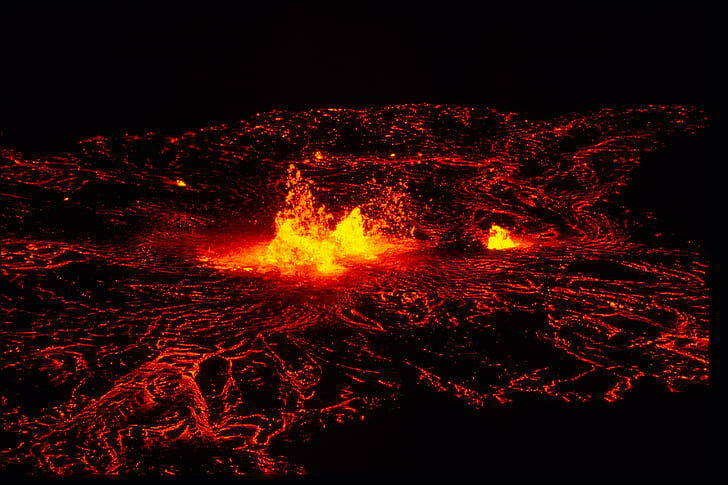
It scares me, that I felt that way. But in noticing that sudden shock of hate in myself, I then considered how deeply and fiercely Trump and his cult have driven their followers to hate, and I became doubly frightened. I experienced a moment of hate, of indignant rage at the moral vacuum I assumed to reside in this stranger’s heart. Just imagine, then, the cauldrons of hate, like geological quantities of magma, seething within those who feel represented by Donald Trump.
For the few seconds that I burned, I struggled to come up with some imaginary scenario in which I might confront this fellow and set him straight. Absurd, of course.
But what about the millions of people, bubbling with hate, and being told to expect their enemies to deny their leader his power—and therefore, in their minds, their power.
I’m very worried about what scenarios they are imagining. I’ve very worried about that.
What I’m also thinking about:
How not to think about everything going on. M.G. Ziegler says, “I think in many ways we can only live through times like these by not stopping to think about them.” I don’t feel like I have that luxury.
So go easy on yourself. Try not to think about the future. Instead, think about the present. How can you win the next hour, the next day? How can you be of most value — to yourself, to your family, to your community, and to the earth itself? You still have the incorruptible capacity to create joy, and catalyze change. No one can take that away from you, no matter how dark they dim the lights.
That’s true. But while one’s capacity might be incorruptible, it is not inexhaustible. And I’m pretty exhausted.
Alan Jacobs writes, in Breaking Bread with the Dead, which I mentioned in the previous issue:
I would ask you, dear reader, to remember the next-to-last thing that social media taught you to be outraged about. I bet you can remember only the last one. …
You can readily see, I suspect, how information overload and social acceleration work together to create a paralyzing feedback loop, pressing us to practice continually [informational] triage … forcing our judgments about what to pay attention to, what to think about, to become ever more peremptory and irreversible. … And all this has the further effect of locking us into the present moment. There’s no time to think about anything else than the Now, and the not-Now increasingly takes on the character of an unwelcome and, in its otherness, even befouling imposition.
No argument here, but this particular Now seems unavoidably pressing. It puts us in a state of what I once called “permanent fret.”
Oh, how I long to be bored again.