pav.alxndr
Leaving the Day Behind (Tablets Re-Reconsidered)
I have been on a kind of device-consolidation kick for a couple of years now, shedding gadgets that I feel overlap in their use-cases a bit too much to justify keeping around. Last year, I wrote about how the tablet was being made redundant by the big-screen phone and the super-light laptop, and, becoming a phablet convert myself, I sold my beloved iPad, and my Kindle to boot. My creativity/productivity stuff was covered by the laptop, and the reading/kicking-back stuff was covered by the phone. What did I need a middle device for?
What I’m coming to realize, or at least be reminded of, is that there is a lot to the psychological baggage of a device (and really, all objects). I work all damn day on my laptop, and it is particularly tweaked and arranged and fussed over to serve that purpose. It is an optimized and remarkably powerful tool for getting my job done. But when it comes time to pursue some kind of creative endeavor or hobby, or just relax and browse, all the distractions and stresses of work carry over. It’s like trying to read a rich novel in the middle of a noisy office. That stuff stays in my head.
The phone is a little different in that it’s the device I use all damn day for, well, almost everything. It’s always at my side or in my hand, getting used. (I do adore it.) Achieving a switching of gears becomes difficult, because that object you wish to lean back and read something on is also the same object that you were just doing texts, emails, calendar checks, and (of you’re me) Angry Birds 2 on. The tactile sensation as well as the visual data of the display size make it harder for me to get away from all of that.
So I can see, once again, why it’s nice to have a middle device that can take on the lean-back tasks and for shits-and-giggles activities that the laptop and phone can also do just fine. It’s about leaving the other stuff behind intentionally.

I was spurred to think more about this thanks to this piece at Medium by Tiago Forte (hell of a name) about the benefits of read-it-later services. He points out that other apps and services can serve the same functions as Instapaper and Pocket, but they bring with them their own baggage:
A common response when I recommend people adopt yet another category of apps is “Why don’t I just use Evernote?” Or whatever app they’re using for general reference or task management. Evernote even makes a Chrome extension called Clearly for reading online content and Web Clipper for saving it.
It is a question of focus. Why don’t you use your task manager to keep track of content (i.e. “Read this article”)? Because the last thing you want to see when you cuddle up with your hot cocoa for some light reading is the hundreds of tasks you’re not doing.
On a laptop, and on your phone as well, all your tasks are literally a click or tap away. Indeed, they may be blinking at you without input needed. And both of these devices invite you to act on those distractions. That’s what’s so great about them: they allow you to do so much. Sometimes you don’t want to do “so much,” though. You want to do very little.
That’s good territory for tablets and e-readers to cover, I think. I don’t know that it’s territory that’s worth, say, top-of-the-line-iPad money to cover, but something more affordable? More modest? Yeah, I can see that. Now. Again.
Is it Okay to Drop Virtual Nuclear Bombs?
 This is probably a ridiculous question, but whatever: Is it immoral to do immoral things in a video game?
Here’s the thing. I have a genuine concern about ultra-violent games, particularly immersive first-person shooters that reward the most ghastly behavior and casual mass-killing. I know this view isn’t popular among Internet-types, but I do worry that spending hours training yourself mentally to slaughter without care must have some deleterious effect on one’s sense of right and wrong. But I don’t know.
But let’s look at a different genre of game. Pretty much the only computer games I ever play, with very few exceptions, are games from the Civilization franchise. (I have not yet been able to make heads or tails of Beyond Earth, but I will try again sometime.) In all of the Civ games I’ve ever played (which go back to Civ III), nuclear weapons can eventually be attained and used against rival empires.
I have always felt very uneasy about them. Which is completely absurd! I seem to have no problem massacring legions of an opponent’s military units or laying waste to its cities, but I always feel like dropping The Bomb on them is somehow crossing a line.
Actually, I do sometimes have a compunction about military action in Civ games. When I first got into them, I always tried very hard to win through things like culture and building alliances. A lot of this has to do with the fact that I’m not by nature very aggressive, that I avoid conflict, and I fear that attempts to militarily win the game will wind up just embarrassing me in front of the other emperors. But it also comes from a genuine loathing of war and violence on principle.
Maybe that’s silly. These are pixels and lines of code, not real humans. But that’s just as true for the pixels and lines of code in something like Call of Duty.
That’s not a perfect comparison, though, because my worry about first-person shooters is, again, that they serve as a kind of training and conditioning for violence by way of a simulation of reality, of a first-person perspective. It’s “you” doing the killing, as opposed to a little digital sprite on a map grid.
But to turn it back again, in Civ you’re not simulating the experience of the soldier on the ground who’s doing the shooting, but you are simulating the person making the decisions about who will try and kill whom. Maybe it’s a conditioning of another kind. It’s not conditioning you to lust for blood and violence at your own hand, or to crave the sensations of blasting away at someone’s body, but maybe it conditions you to no longer see people as a collective of individuals, but as data points on a map, as resources or obstructions to resources. I guess it could be argued that these are both dehumanizing in their own way.
And maybe that’s why using nuclear weapons in Civ games bothers me. Now, I have and do use them. I usually eventually accept the terms of the game I’m playing, and bombs away. But I always feel weird about it.
If there’s a parallel to the dehumanizing effects of immersive first-person shooters and bird’s-eye-view strategy games, I don’t for a second think they’re equal. I do suspect (I don’t know, I suspect) that there’s something about first-person shooters that’s visceral, that works below our consciousness, something that specifically stimulates the fight-or-flight system in our lizard brains. Strategy games, if they do anything similar, can’t possibly act on such an animalistic, atavistic level. But they might do something.
And they might say something. When I railed against the violence coolly perpetrated against women in video games (for which I got no end of hostility), I was concerned about how they could effect behavior, but I also worried about what they said about us. I didn’t like that we had an incredibly popular entertainment medium that celebrated this kind of reprehensible brutality, and I wanted us to demand better of ourselves, even our simulated selves.
So maybe that’s why I hesitate before launching those nuclear missiles in Civ. I know it’s not real, and I know I’d never use these kinds of weapons in real life if I were in a position to do so.
But I guess I’m not entirely comfortable with what it says about me, and about us, that I do use them in this game. I guess that even in a totally manufactured, fictional universe, I would like to think better of myself.
Lurve the Curve: The LG G4

In my last tech-related post, I detailed my year-long persnickety quest to find the One True Phone that I could finally, finally call my own. As I wrote then, I ended up with the LG G4, with a commitment to stick with it for the next year. Luckily, I made very much the right call.
I adore this phone, and I really wish I had picked it up as soon as it was released. Here’s some reasons why.
The most important part of a phone experience for me is the display quality, and this has the best display I’ve ever used. One might argue that it's Samsung’s Super AMOLED displays on the Galaxies S6 and Note 5 that are the absolute tops, but to my eyes, Super AMOLED causes truly palpable eye strain, especially when I’m doing any long-term reading on the device. (One Reddit commenter suggested it might be due to an imperceptible "flicker" in AMOLED, but I don't know for sure.) Given that book-reading is one of the primary things I do with a phone, an IPS LCD is by far a better solution. And I’ve never seen a better one than that of the G4. Sharp, vivid, bright, and, importantly to me, very pleasant to read off of.
Now, of course, this phone has the particular quirk of being ever-so-slightly curved. When LG introduced its Flex line of seriously-curved phones, I rolled by eyes. It seemed a pointless gimmick, but now I’m a believer. The curve on the G4, which is far subtler than that of the Flex phones, really does make the phone a joy to hold. It sits happily in the palm, and something about the arc even makes the weight of the phone rest in just the right places. The display isn’t distorted by the curve, and actually feels nicer to swipe around on, with a little swoop you can feel. If anything, I wish the phone had just a bit more of a curve. I lurve the curve.
Like the G3 before it, the buttons are on the back, which is exactly where they should be. It’s so obvious and natural, I can’t believe that this configuration isn’t more common. I can double-click the volume-down button when the screen is off to launch the camera, and double-tap the screen to wake up the phone. Excellent.
The performance is great. It’s not the powerhouse that the Note 5 is, where everything happens absurdly fast, but the G4 is plenty quick. There are occasional instances of lag, weirdly sometimes with the camera shutter, but on the whole, it’s an extremely smooth experience.
Oh right, the camera. It’s phenomenal. I actually like it better than the ostensibly “better” camera on the Note 5, because it looks to me that the G4 gives me more true-to-life images, less saturated, and more finely detailed.
Battery life is fine. I’ve had no problems, and if I did, I can swap the battery out.
And guys, the backs are swappable. The base model I got was a deep blue color, which was okay. The bezel and buttons in blue looked better than the plastic back, which didn’t look great, with an uninteresting diamond pattern. But then I slapped the red leather back on it, and it now looks and feels fantastic. Not like a technology product, but more of an organic object, not unlike a small book. The deep blue buttons popping out of the deep red leather back is really classy looking. It even smells good!
And here’s something I discovered wholly by accident. The other day I had the phone in my hand, I think to grab a picture of my kids doing something silly (as usual), and I needed to deal with a smudge on my glasses. Holding both my spectacles and the phone, I realized that, entirely unintentionally, I had bought a phone that matched my glasses. If you can't tell from the image below, there are dark-red arms on the specs, dark-blue frames around the lenses.

It really was meant to be.
The DNC's Cowardice Kills the Lessig Campaign
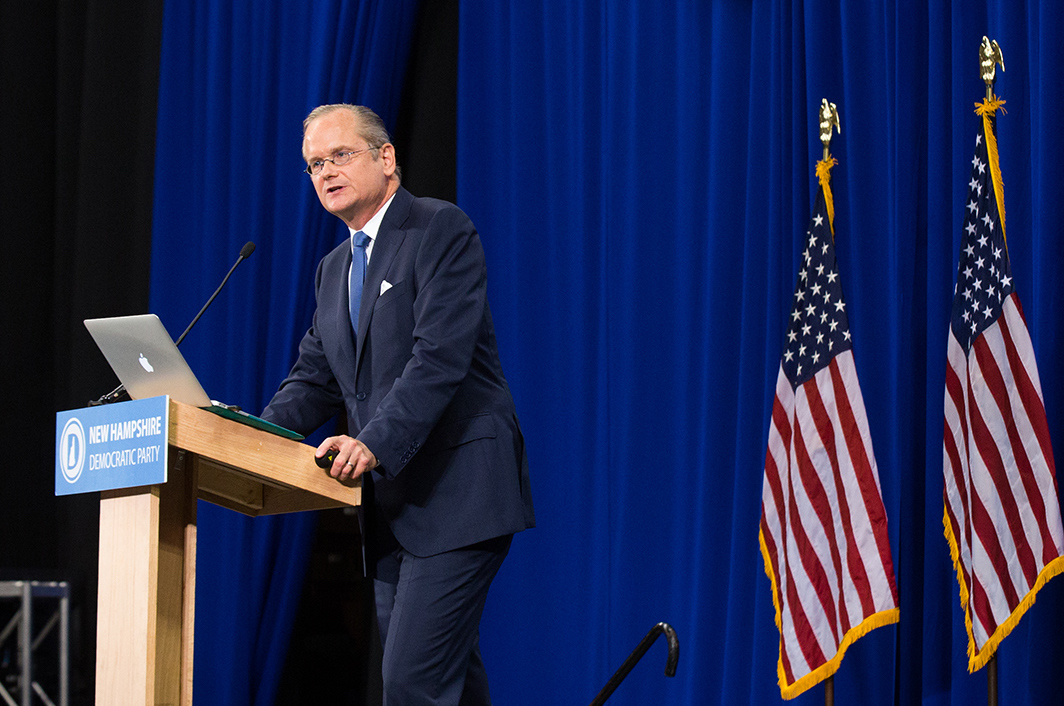 Lawrence Lessig ended his bid for the Democratic nomination for president today, and I don’t blame him in the least. Due to a last-minute change by the Democratic Party in the rules to qualify for the debates, Lessig was blocked. He accounced his decision to end the campaign in this video:
[youtube [www.youtube.com/watch](https://www.youtube.com/watch?v=u4IsqmMqCEo])
I’m heartbroken, and I think he is too. I had no illusions that he would be a serious contender for the nomination, but I desperately wanted him on that debate stage. Someone has to make the case for the The One Issue to Rule Them All, fundamental reform of the electoral system. Reform of the systems by which we fund elections, vote for officeholders, and design our legislative bodies really is at the very core of all the other challenges we’re unable to politically confront. But almost no one knows that, or at least they don’t think about it. Lessig, if nothing else, would have made at least a few of us think about it.
I’m heartbroken, too, by the cowardice of the Democratic National Committee. For some reason, they decided that it was in their interest to keep Lessig off of that debate stage. I can think of several reasons why, but all of them are so petty and pathetic, that I am loath to attribute them to the party that ostensibly represents my interests. But who are we kidding? One thing the Democrats have not been known for in many generations in courage. Could they really have been so afraid, or at least squeamish, about Lessig’s message? It’s a message that points out the pox on both houses, but it also offers the vaccine for that pox. I am embarrassed for, and of, the Democratic Party.
I’m disappointed at the Clinton, Sanders, and O’Malley campaigns for not advocating on Lessig’s behalf. None of them had anything meaningful to lose by Lessig’s inclusion, certainly not Clinton. Lessig was running as a Democrat because he supports Democratic principles, and was not running to “take down” any of the other candidates. He wasn’t there to “get” them, but to be serve as a kind of conscience. Bernie Sanders is supposed to fill that role, I suppose, but he doesn’t get close enough to the core of what’s wrong. They should have insisted he be included. But of course they wouldn’t.
And I’m seething over the political press, who, when tweeting the news of Lessig’s exit, offered only snark, jokes at his expense. I understand the delight one can take in the failures of ridiculous candidates, the hilariousness that ensues when their hubris far outshines their qualifications or competence. But Lessig wasn’t one of those candidates. He’s a serious, brilliant, accomplished person with a core message that is of existential importance to the republic. But ha-ha, he had to quit, couldn’t get one percent, funny glasses, ha-ha. Whatever plague is making our democracy sick, these people are the rats helping it to spread.
I don’t know if things would have been any different if Lessig had not begun his campaign with the pledge to resign once his legislative agenda had been fulfilled, a pledge he recently recanted in light of the resistance to it, and the fixation on it. I have to think it would have at least helped for the “gimmick” of his candidacy to be the sole focus it ever received from the vapid press.
It seems Lessig is leaving the door open ajar for a third-party candidacy, but I don’t think that’s what he wants. We’re all rolling our eyes at the idea of a Jim Webb independent run, and the last thing Lessig wants is to seem like more of a political joke than the press is already making him out to be.
The point, Lessig says himself, was to get into the debates. That’s where he was going to have his maximum impact. And the Democratic Party has slammed the door in his face. I don’t know what he should do next, although in his blog post following his official announcement, he wrote in a parenthetical:
…first lesson for presidential candidate wanna-be’s: be a Senator first, so your salary can be paid while you’re running for President.
How about it, Larry? You almost ran for the House once. Maybe it’s time to get in the fray at the legislative level. Kick some ass in Congress, and then we’ll see what happens next.
Lessig Says "You Win...I Will Remain President" - But It Might Be Too Late
 Lawrence Lessig has reversed himself on the one aspect of his presidential campaign that I considered deflating, that dampened what would otherwise have been true enthusiasm: He’s no longer pledging to leave office once he achieves his legislative objectives. He means to be president and stay president. He wrote at The Atlantic:
If the Democrats won’t take seriously a candidate with a viable, credible, and professionally managed campaign just because it includes a promise to step aside once the work is done, then fine. You win. I drop that promise.
I am running for president. … After we pass that reform [the Citizen Equality Act], I will remain as president to make sure the reforms stick. I will work with Congress to assure they are implemented. I will defend them against legislative or legal attack.
But beyond that priority, I would do everything else a president must do, too. Which means I bear the burden in this campaign of convincing America I could do that well.
Excellent. I’m delighted by this.
But it’s almost certainly too late to matter.
After the first Democratic debate last week, I said that the quality performances of the first-tier candidates more or less ruled out a Joe Biden candidacy, as the debate made clear that there was no need for either an establishment alternative to Hillary Clinton, nor a left-flank alternative to her or Bernie Sanders. The two of them both did well enough for themselves to settle the race as one between the two of them, and the remaining three candidates were rendered more irrelevant than they already were, if that was even possible.
So my concerns for Lessig are that, first, his being left out of the debates has as much to do with resistance to true reform candidates from the DNC as it does with poor poll showings, or being left out of polls altogether. That resistance certainly won’t have changed now that Lessig is promising to remain president, and the DNC has little interest in someone standing on stage saying that the whole system that keeps them (and the GOP) in power is the real problem. It is the real problem, the problem from which all other problems flow, but it boots the Democrats nothing to admit it.
But second, and probably more importantly, I'm afraid that the moment has passed for grassroots excitement for Lessig to compel the networks, or whoever else has veto power, to care whether or not he’s there. To this time, I have not seen the kind of unbridled enthusiasm for Lessig’s candidacy that I would have expected, especially from the young, civil liberties-minded, Silicon Valley crowd, and I chalk this up to his poorly conceived resignation pledge. Now that he’s wisely reversed himself on this, that enthusiasm has now been channeled largely toward Bernie Sanders. In other words, Sanders is sufficiently reform-minded to sate the appetite for change that Lessig represents. And the debate last week only solidified that state of affairs.
I truly hope that new interest is sparked in Lessig’s campaign, again, not because I think he has any chance of being nominated or elected, but because his message is so vital. The agenda he champions is literally of existential importance to our democracy. A man of his wisdom, intelligence, and humanity carrying a message of achievable and necessary democratic rebirth deserves and needs to be on the next debate stage. He needs to be heard, and the other candidates, the ones who actually can be president, need to address them.
I just despair that it simply won’t happen now. The moment, I fear, has passed. Please, let me be wrong!
How I Learned to Love the Chromebook

I’ve been singing the praises of Chromebooks for some time, but none of that praise has come from direct experience. The utility and potential of these devices have been starkly obvious to me, though I’d never had occasion to test them on myself. I’ve always had a perfectly good laptop, a phone, and sometimes even a tablet (I don’t have one of those right now, and I kind of miss it), so having yet another device was not something I could justify. Financially. To my wife, mostly.
Then, like a superhero bursting through the clouds to come to my rescue, my former theatre colleague Tom Loughlin suggested I borrow his old Dell Chromebook 11 and try it out. He knows I’ve been bullish on them, and he wanted me to do some writing about what it was like to actually use one, and I was all what? and he was all yeah! and he shipped it to me.
But this was weeks and weeks ago, and other than start the thing up, I did essentially nothing with it.
Because what was I going to do with it? Like I said, I’m already fully decked-out tech-wise. There never emerged an impetus to bust it out, no need arose. So it sat in the box Tom had shipped it in, and I felt guilty.
And then in one day it dawned on me, weirdly, twice.
I work from home, and my office is upstairs in a big walk-in closet in the back of our bedroom. When my MacBook Pro is in full “work mode,” it’s on my desk, hooked up to power, hardwired to the Internet, and connected to my backup external hard drive. Sometimes it’s also got a microphone hooked up (for the podcast usually), and has at times also had a monitor, mouse, or what have you. And this is how it was a few days ago.
And I wanted to make my lunch. Downstairs.
But still be able to work. Because I’m just like that.
As you can imagine, I didn’t want to unhook everything (and of course “safely eject” the hard drive) and bring my MacBook downstairs, only to run it back upstairs and hook it all up again.
That’s when I remembered the Chromebook.
And here’s the amazing part. I had the idea to use it, I opened it up, logged in with my Google Apps credentials, and that was it. Everything was there, and I could just work. I could do everything that I would normally do for work, too. It was almost entirely frictionless.
But of course I didn’t only want my work account set up! I wanted my personal Google account up and running, too. And it took me literally a couple of minutes to figure out how to have two “instances” of Google accounts running on the device at the same time. So now I could work in one account, click an icon at the bottom of the screen and instantly switch right over to the other account. Again, almost entirely frictionless.
That’s how I worked for a little while. And when I was ready, I closed it, and went back to my office.
That was one. The other happened later that evening. We don’t do cable at our house, so we had to get CNN’s live stream of the Democratic debate, and watch it on our living room TV. CNN wouldn’t allow the video to be cast over to our TV, so to do this I had to connect my MacBook via HDMI, which also meant that my computer would be physically tethered to our TV, which meant that I couldn’t use it do the one thing I love more than watching presidential debates: tweeting presidential debates.
And then I remembered: the Chromebook.
Usually, in this situation, I’m stuck tweeting on my phone, which isn’t nearly as easy when you’re doing so in a rapid-fire manner as I do during events like this. But this time, all I had to do was open up the Chromebook, sit back, and knock out my HILARIOUS tweets in a full-function instance of Tweetdeck, just like I would have done on my Mac. No beats skipped. (I also wrote and published this post using only the Chromebook.)
So this is what the Chromebook is to me, right now: a lightweight extra computer. In many ways, it’s what I’d always wanted out of an iPad; a casual computing device that asked very little of me, was smartly limited in its functionality, but could still do the basics without any friction. The iPad was great for, say, reading and browsing, but not for working. The Chromebook is not my reading device of choice by any stretch of the imagination (my phone is now), but for simply getting shit done without being laden with all the computer cruft, it’s great.
That doesn’t mean I can now justify getting one. I still don’t need it, the same way I don’t need a tablet, and yet would still like to have one. But now its utility for someone like me is much clearer. Simply put, it’d be a great second, kicking-around computer.
And truly, if I didn’t have some particular media-creation needs, a Chromebook would serve as my main computer without a problem.
So right now I’m in a mode of “it’d be nice to have one” for Chromebooks, but there’s still some evolution that needs to happen before it crosses into “oh man I really need to sell off some of my valuables to get one.” I think what I’d really like is for the Chromebook to get closer to absorbing more tablet use-cases, where the keyboard goes away (either by detaching or flipping around or whatever) and the laptop becomes a single slate that can be used as more of a casual reading and browsing device; lean-back instead of lean-forward.
Asus’s Chromebook Flip is the right idea, actually, but there’s one problem I have with it: the screen resolution. I’m spoiled by, and now married to, Retina-level resolutions, and especially if I’m going to use something to read off of, it’s got to be crispy. If Asus were to put one of these out with over 300ppi, I’d be all in.
This, really, was my only real problem with the 2013 Dell Chromebook 11: the display is garbage. Utter shit. Not only is it low-resolution, but it’s washed out, with colors rendered, well, vaguely. The rest of the laptop’s hardware was fine. It’s plenty zippy, the trackpad was acceptable, and the keyboard was fine. But that screen, blech.
The point is, however, that even though I was already a Chromebook booster, I’m now a fan. This is a great category of device, and I can’t wait to see it get better, and then to get my own.
(And sincerely, thank you, Tom!)
The Democrats' First Debate: Nothing Changed, and That's Huge
 In a sense, nothing really changed about the dynamics of the race as a result of the first Democratic presidential debate, but that in itself is extremely important. Clinton performed as excellently as I expected, and probably reminded many folks why they liked her to begin with. Sanders also did himself some good by setting himself up as a substantial and passionate contrast to Clinton. With neither of them making any meaningful mistakes, they served to solidify the existing situation, which is a win for Clinton.
O'Malley may have helped himself to a percentage point or two in the polls, if for no other reason than that he was fluid and enthusiastic, and appeared to be a plausible alternative to the current top tier. But he gained nothing that truly effects Clinton's or Sanders' positions. I do have to wonder if O'Malley's slickness came across as sincere or contrived to the average viewer. He was laying it on quite thick at times, and as an actor and a veteran political observer, I don't trust my own view to know how he comes across to others.
Webb and Chafee performed abysmally. I was genuinely embarrassed for both of them, especially considering that they both seem like good, well-intentioned public servants who would otherwise probably deserve a fair shot at consideration. But Webb was all grouse and resentment (and weirdly threatening China), and Chafee was an unmitigated disaster. I can't think of anyone in a presidential debate who has ever performed as poorly as Chafee did tonight, and I'm including Quayle. For his own sake I hope he drops out tonight.
But again, Webb and Chafee had no effect on the larger race, and tonight really only served as a chance for voters to rule them out, and perhaps -- perhaps -- consider O'Malley. Which merely buys O'Malley a point or two at best.
So, as I said, this debate changed very little, other than to settle the race for a while, to where it more or less has been anyway.
With one exception: Joe Biden.
I don't know if Biden is still considering running, and I'd be shocked if he was. But after tonight, it doesn't matter. By not participating in this debate, I believe Joe Biden ruled himself out of the race. The fashionably late don't get to be president, and, learning the lessons of Wesley Clark, Rick Perry, and Fred Thompson, he must know that. Biden is, as of tonight, a non-factor in this primary race.
And that is a big, big win for Hillary Clinton.
Power's Out
The power went out on my block tonight, and it was weird. It started around 10pm, I was the only one awake in the house, and there were no lights outside either. So here I was, alone, in a big blanket of near total darkness. Except for my phone, of course. Which I used to draw this. Me, a little freaked out, in the dark.
<img src="http://nearearthobject.net/wp-content/uploads/2016/03/wpid-wp-1444705554360.jpg" alt="">
Finally getting to get some creative use out of the stylus on the old Note 5. Which I also used to write and publish this post!
Oh, and literally the moment I posted this picture on social media, the power came back.
Lawrence Lessig, Knight of the Woeful Countenance
 If Hillary Clinton is my Machiavellian Prince, Lawrence Lessig is my Don Quixote. I know he can’t win (and he knows he can’t win), but his platform, his cause, is closer to my heart than perhaps any candidate’s has ever been.
That cause is one that goes beyond the litany of issues that confront our country and our planet, because it is the One Issue to Rule Them All, the crux of everything, which, if not decisively solved, will mean that nothing else truly meaningful will ever be accomplished. Of course I’m talking about reform of the political system itself.
Yes, that means the money in politics, but that’s actually the least interesting part to me. Don’t get me wrong, fundamentally upending the way we fund elections is vital to fixing the system at large, both in real terms as well as in how politicians are perceived.
There’s also the question of voter equality: access to the franchise, an opt-out rather than an opt-in voter registration paradigm, and for the love of Jiminy Cricket, make Election Day a federal holiday.
But while these two are the easiest to grasp of the three prongs of Lessig’s “Citizen Equality Act” (too much money bad!!!), I think they are secondary to the biggest problem.
That’s the electoral process. Not the way we fund or run campaigns, but the systems, the mechanisms by which we vote. Here’s what Lessig’s website says about this part of the Act:
Equal citizens must have equal representation in Congress. That means, districts must be drawn, and election systems structured, so as to give each citizen as close to equal political influence as possible. FairVote has offered the most comprehensive solution to achieve this equality. At a minimum, the Citizen Equality Act would incorporate their proposed “Ranked Choice Voting Act,” which ends political gerrymandering and creates multi-member districts with ranked choice voting for Congress.
(Oh, and allow me to remind you that I used to be FairVote’s communications director in the late Aughts, so you can imagine how proud this makes me.)
The way we elect our officeholders is pure crap. It’s garbage, because for single-seat offices like governors and senators, it allows a tiny plurality to claim victory, even when opposed by the majority. (Best example ever? My own state of Maine, where twice Paul LePage was elected with a pathetic plurality of votes thanks to a three-way race, despite the fact that most of the state hates his guts.) If we have a system by which we can rank our choices, sending our votes to back-up choices if our first choices aren’t viable, we will wind up with winners that reflect the actual will of the majority far more often.
In multi-seat bodies like legislatures and city councils, it’s also crap. Galactic-level crap. But this gets kind of complicated to explain, so I’ll let FairVote do it. And of course, that complexity is why the issue is so utterly unsexy, and why the necessary reforms to fix this shitshow are so hard to sell. I know, I tried.
The point is that this is the stuff that will really achieve change. When we stop getting election results that reflect only a warped version of the will of the voters, when we stop blocking access to voting to those we don’t agree with, and when we open political influence to more people than those with loads of cash, we can then, and only then, begin to make a dent in things like climate change and economic inequality.
But now we come full circle to reality. The Imperial Destroyer that is the U.S. of A. will not be so easily retrofitted and modified into the speedy and nimble fleet that it ought to be.
And Lessig won’t be president. Shit, he won’t even be allowed into the debates so that these issues can at least be tested out on the national stage.
But you know what gives me a little hope? Lessig’s interview this past Sunday on Reliable Sources. It gave me a little hope because I saw something I didn’t expect: a fire in Larry’s belly. I’ve always said that you can never underestimate the candidate that really wants it, and you can usually tell which ones don’t. (Feeling entitled to it is not the same as really, really wanting it.) Lessig’s always been passionate about his core issues, but this is the first time I’ve seen him truly roil.
He pokes fun at himself, his appearance, and his “funny glasses” (that I really like but could never pull off myself), but even if he has no chance at being elected, he could still take that quixotic passion and be our Knight of the Woeful Countenance.
Yes, I'm Conflicted About Hillary Clinton. But I'll Damn Well Get Over It.
 I have lots of feelings about Hillary Clinton. Heck, I used to work for Hillary Clinton. She had no idea, of course, but for about three months as 2007 turned into 2008, I was a media researcher for her presidential campaign, more or less the guy standing at the castle parapets yelling “incoming!!!” whenever anything of any note whatsoever was said about her in more or less any medium. (It was so stressful and frenetic that my body almost entirely shut down, and I had to quit after being on the job for what were, admittedly, the worst three months of the campaign for her. At one point we actually thought I might have brain cancer!)
(I didn’t.)
Showing up hither and thither in my social media streams this weekend has been this excellent piece at Elle by Rebecca Traister, and it in many ways echoes my own panoply of loves and loathings in regard to Secretary Clinton. For Traister, I gather, the internal conflict is mainly about the ideological boxes Clinton has not checked (or checked too late), versus the burning need -- personally for her and for society as a whole -- for a brilliant, mega-qualified woman to be, not even just elected president, but even be treated fairly as a presidential candidate.
My conflicts are in a similar vein, but they are more strategic, I suppose, than ideological. Like Traister, I too desperately want us to get over this ridiculous hump and finally, for the love of sweet flappy jeebus, elect a woman president. Like Traister, I fume and nurse ulcers over the grotesque personal scrutiny to which this woman is regularly subjected, the grossly unbalanced way she’s covered as a candidate, and the need the press establishment feels to bring her down, to make her “sorry” for, well, whaddaya got?
But I’m far less ideologically conflicted. I understand that she’s never been the Perfect Liberal. I totally get that my well-meaning friends who support Bernie Sanders do so because he holds positions that satisfy most liberal orthodoxy (which I largely support as well), and that he has skillfully positioned himself as a man of the people who tells it to you straight. It’s probably mostly sincere! And that’s great. Go, Bernie! Seriously!
But that’s not the kind of person who gets shit done from the highest reaches of global power. Running any government is often compared to steering a giant ship, where one can only make minor adjustments to the course at any given time, given the speed, weight, and size of the vessel. Running the U.S. government, including its innumerable foreign-policy tendrils, must be more akin to trying to steer an Imperial Star Destroyer. In the water.
What I’m saying is that being an effective President of the United States means being able to intellectually process vast amounts of data; to have extraordinary insight and empathy into myriad sensibilities, needs, and hopes; to have the grit to make extremely difficult decisions, not just about war and peace or life and death, but about what small concessions to make or what humiliations to endure to advance a larger cause. To put it more starkly, this person needs to be able to wisely and decisively know when to compromise even foundational tenets of morality, democracy, and ethics in order to score a meaningful win for the greater good.
(The Bush administration believed it was doing so when it decided that systematized torture and a doctrine of preemptive war were an acceptable trade for national security and economic pillage. But that’s another thing.)
I’d bet there are only a few people on Earth who can even bring themselves to even make such decisions, let alone make the right ones. I don’t think Bernie Sanders is that kind of person. He’s clearly a good, intelligent man, but frankly, he’s not Machiavellian enough. Not to my tastes. I’m sour on Sanders the presidential candidate because I don’t think he’s ready to confront the ugly and the uglier, and figure out the difference.
Clinton is. This woman is better suited than probably anyone on the planet to steer the star destroyer, nudge by nudge, by crucial and perilously timed fractions of degrees. She’ll have the brains and the guts, I think, to make the tough calls, and even the horrible calls, to do the right thing. Yes, I want The Prince, and I want The Prince that’s on my side.
And guess what, this is also where my conflict sets in. Look at the 2008 campaign, and you tell me if she made all the right horrible calls in order to advance the greater good. Was doing anything suggested by Mark Penn ever a good idea? Was refusing to say outright that Barack Obama was not a Muslim a good idea? Was hiring a staff that bullied and belittled the journalists covering the campaign a good idea? (I was in the room for a lot of those calls.) No, they were not.
So she’s willing to do the dirty work, she’s willing to go for the throat when the times call for it. I’m not 100 percent sure she’s sufficiently wise enough of the time to go for the right throat at the right time. Just as there is something pathological about the press corps’ need to see her suffer, there is something strangely chronic about Clinton’s ability to set her own landmines, and pretend they’re not there. I felt queasy as journalists were tweeting banal (and even at times endearing) personal emails from Clinton’s servers, but I feel just as sick over the idea that she had such a server, and seemed to think nothing would come of it. Why does she (and/or her universe of functionaries) let these things happen?
Ideologically, I’m more or less fine with Clinton. She came to gay marriage late, fine, so did most of anyone in the party who matters. She made the wrong horrible choice on the Iraq vote, but, again, she was hardly alone. (And I’m more sympathetic to foreign adventures than most of my liberal brethren, but come on, even I knew the Iraq invasion was a contrived bullshit boondoggle right off the bat.) But on the vast array of issues before us, she’s on the right side. She “cozies up to Wall Street”? Good! I hope she cozies up to them so close that they don’t even feel it when she sticks a knife in them and bleeds them out.
And the bottom line for me is that we essentially have the choice between a flawed but fiercely powerful and qualified Hillary Clinton, or the political equivalent of an asteroid strike with the election of any of the Republican candidates to the presidency. It’s hard to calculate the damage such an impact would cause, but it would blot out the sun for ages.
To beat whichever craggy planetoid the GOP throws at us, I want the candidate who will come at them with ruthless, superior force. Because I want more, not fewer liberal justices on the Supreme Court. Because I want a stronger wall of separation between church and state. Because I want economic policy that stops simply shoveling money toward the already-rich. Because I want a president who gives two shits about equality, education, science, and fucking nuance.
And I want a goddamned woman president.
So I’ll get over my conflicting feelings. Let’s get this damned star destroyer pointed in the right direction.
Transhumanism as a Possibility, Not a Promise
 I have a soft spot for the transhumanists, and as I’ve said, if they were a little less sure of themselves and their goals, and if they were just a little less, well, religious in their faith about what technology and artificial intelligence will bring, I could see to donning the label myself.
Zoltan Istvan, the movement’s (and party’s) presidential candidate is the embodiment of this faith. A huge, strong fellow who has led a life that resembles Indiana Jones-meets-extreme sports, he has put himself at mortal risk countless times, only to undergo a kind of revelation about just how fragile and short life – even his – can be. Now he’s a kind of missionary for immortality, using his presidential campaign (such as it is) to get us talking and thinking more seriously about making life-extending technologies a prime priority for society.
After reading a fascinating “campaign trail” report by Dylan Matthews at Vox on Istvan, and watching Istvan’s 2014 TEDx presentation, I think I see something that distinguishes Istvan from what I normally think of when considering transhumanism.
To me, transhumanism is advocacy of the utilization of technology to radically improve, augment, and transform human life. Its “faith” is that machines and humans will merge in one form or another, and very soon, so that there will be no distinguishing between flesh and robotics, computer and brain, software and mind. And this is supposed to happen in the next few decades, in what’s called the Singularity. The person most associated with this line of thinking is of course futurist and inventor Ray Kurzweil, now a lead engineer at Google. He is the transhumanists’ equivalent of a prophet, and he is himself obsessed with keeping himself alive as long as possible in order to experience this Singularity himself.
If I were to paint in the broadest of strokes, I’d say that the Kurzweilian transhumanists are very much jazzed about the gee-wiz of technology, the wow-factor of look-what-we-can-do. Having a brain uploaded to a super-internet, enhanced by unfathomably powerful computers, is a kind of Rapture, a removal from existence as we know it. Maybe this isn’t a fair characterization, but it’s how it seems from my vantage point.
Zoltan Istvan is, I now think, a little different from this. If you take him at his word, he is after not advancement for advancement’s sake, but for “beauty.” As he says in his TEDx talk, “Unless you are alive, it is impossible to experience beauty.”
And it seems to all stem from this. The idea that death is a ridiculous waste, and that life offers so much beauty and enrichment, the likes of which we as mere homo sapiens have barely scratched the surface. In order to truly know what he calls “new concepts” and “new arenas” of beauty, we have to, first, not be dead (obviously), and second, invest in the kinds of technologies that will allow for this kind of life extension and experiential enhancement.
As someone who is on the record (severally) as one who fears death like nobody’s business, I am deeply sympathetic to this…what is it, aspiration? Wish? I wholeheartedly share Istvan’s view that death is something to be avoided and ultimately conquered, because as far as we silly meat-robots are concerned, there is literally nothing beyond our experience of this one short life. If we are a way for the universe to know itself, as Carl Sagan put it, I really do feel like the universe should get more of a chance to do so by not letting its intelligent, sentient creatures die.
And there was one more thing that surprised me about Istvan, and this from his profile by Dylan Matthews, who was joined on the Immortality Bus by fellow journalist Jamie Bartlett:
On many matters, Zoltan openly concedes that he just doesn’t know what to do. … To Jamie, who in addition to writing for the Telegraph is working on a book about “political revolutionaries” for Random House, this is striking. The other chapters in Jamie’s book profile movements characterized by unwavering faith in an inviolable set of principles. He’s writing about ISIS, about neo-Nazis, about radical Islamists in Canada. These are people willing to take extreme measures precisely because they know they’re right. That raises the question: Zoltan has a beautiful home, with two beautiful daughters. His wife makes a healthy living for the family, and he can get by as a futurist on the speaker circuit too. He could be in his bed with his wife, knowing that his kids are safe in the next room…
But instead, he’s sleeping on the side of the road in a decrepit 37-year-old RV without running water. Why, Jamie asks, if you’re not sure your ideas are correct, are you willing to go through all this? Zoltan shrugs. He’s not sure. Nobody’s ever sure. But he thinks his beliefs have better odds of being true than the alternatives. Otherwise, he wouldn’t believe them.
He’s not sure. And he can say so. It makes me feel a little better that what Istvan is selling is not a promise, but a possibility. This is probably why he refers to it as “the transhumanist wager” and not “the transhumanist guarantee.” He’s betting on this path to a better future, because why not? Why not invest heavily in technologies that will improve our lives, enhance our abilities, and perhaps one day eradicate death itself? Of course a comparable investment in ethics will be required for such a path, but there are positive dividends to be gained from that as well.
I suppose the “why not” could be the dangers of explosively advancing artificial superintelligence, a danger that folks from Nick Bostrom to Elon Musk are warning us against. In this line of thinking, the superintelligent machines (or machine) won’t give two figs about human lifespans or our experience of beauty, and rather pose a kind of threat in which our extinction is a small event.
So despite the enthusiasm of Istvan, or Kurzweil or any transhumanist for that matter, I can’t get too pollyanna about this. Set aside the actual feasibility of the transhumanist wager being won, I don’t feel like I can even spare the emotional investment in such a future. Can there be more of a crippling, depressing letdown than to believe that death will be conquered, only to discover that it won’t? “The human being is not a coffin,” Istvan says, but for now, it is, eventually.
Perhaps this makes me a lazy transhumanist, or a spectator transhumanist. I’m not yet willing to go there with them, but it isn’t to say that I don’t want them to keep going there. I think what I also want from them, then, is to do a little more of what I glimpse Istvan doing: admitting that they might be wrong.
-------
Related posts:
The Mutual Enhancement Society: Superintelligence in Machines...*and* Humans?
 Reading Nick Bostrom’s Superintelligence, and having read James Barrat’s Our Final Invention, as well as consuming a lot of other writings on the dangers of rapidly advancing artificial intelligence, I was beginning to feel fairly confident that unless civilization collapsed relatively soon, more or less upending most technological progress, humanity was indeed doomed to become the slaves to, or fuel of, our software overlords. It is a rather simple equation, after all, isn’t it? Once the machines undergo a superintelligence explosion, there’s really nothing stopping them from taking over the world, and quite possibly, everything else.
You can imagine, then, how evocative this piece in Nautilus by Stephen Hsu was, an article that explains that actually, it’s going to be okay. Not because the machines won’t become super-advanced – they certainly will – but because humans (or some humans) will advance right along with them. For what the Bostroms and the Barrats of the world are (may?) not be taking into account is the rapid advance of human genetic modification, which will allow for augmentations to human intelligence that we, with our normal brains, can’t even imagine. Writes Hsu, “The answer to the question ‘Will AI or genetic modification have the greater impact in the year 2050?’ is yes.”
First off, Hsu posits that humans of “normal” intelligence (meaning unmodified at the genetic level, not dudes off the street) may not even be capable of creating an artificial intelligence sufficiently advanced to undergo the kind of explosion of power that thinkers like Bostrom foresee. “While one can imagine a researcher ‘getting lucky’ by stumbling on an architecture or design whose performance surpasses her own capability to understand it,” he writes, “it is hard to imagine systematic improvements without deeper comprehension.”
It’s not until we really start tinkering with our own software that we’ll have the ability to construct something so astonishingly complex as a true artificial superintelligence. And it’s important to note that there is no expectation on Hsu’s part that this augmentation of the human mind will be something enjoyed by the species as a whole. Just as only a tiny handful of humans had the intellectual gifts sufficient to invent computing and discover quantum mechanics (Turings and Einsteins and whatnot), so will it be for he future few who are able to have their brains genetically enhanced, such that they reach IQs in the 1000s, and truly have the ability to devise, construct, and nurture an artificial intelligence.
It is a comforting thought. Well, more comforting than our extinction by a disinterested AI. But not entirely comforting, because it means that a tiny handful of people will have such phenomenal intelligence, something unpossessed by the vast majority of the species, they will likely be as hard to trust or control as a superintelligent computer bent on our eradication. Just how interested will these folks care about democracy or the greater good when they have an IQ of 1500 and can grasp concepts and scenarios unfathomable to the unenhanced?
But let’s say this advancement is largely benign. Hsu doesn’t end with “don’t worry, the humans got this,” but rather goes into a line of thought I hadn’t (but perhaps should have) expected: merging.
Rather than the standard science-fiction scenario of relatively unchanged, familiar humans interacting with ever-improving computer minds, we will experience a future with a diversity of both human and machine intelligences. For the first time, sentient beings of many different types will interact collaboratively to create ever greater advances, both through standard forms of communication and through new technologies allowing brain interfaces. We may even see human minds uploaded into cyberspace, with further hybridization to follow in the purely virtual realm. These uploaded minds could combine with artificial algorithms and structures to produce an unknowable but humanlike consciousness. …
New gods will arise, as mysterious and familiar as the old.
We’re now in transhumanist, Kurzweil territory. He’s not using the word “Singularity,” but he’s just shy of it, talking about human and computer “minds” melding with each other in cyberspace. And of course he even references “gods.”
This strikes me, a person of limited, unmodifed intelligence, as naïve. I’ve criticized transhumanists like Zoltan Istvan for this pollyanna view of our relationship with artificial intelligences. Where those who think like Istvan assume the superintelligent machines will “teach us” how to improve our lot, Hsu posits that we will grow in concert with the machines, and benefit each other through mutual advancement. But what makes him so certain this advancement will remain in parallel? At some point, the AIs will pass a threshold, after which they will be able to take care of and enhance themselves, and then it won’t matter if our IQs are 1000 or 5000, as the machines blast past those numbers exponentially in a matter of, what, days? Hours?
And then, what will they care about the well being of their human pals? I don’t see why we should assume they’ll take us along with them.
But, what do I know? Very, very little.
Let's Get Small

I’m a small guy, at 5'5" I think some people almost find it alarming how tiny I am, at least compared to how tall they expect me (or any adult male) to be. It’s me in the context of other people, the relative scale can be surprising.

On my Galaxy Note 5, it has a one-handed small-screen mode, where the contents of the display shrink for ease of use with one hand. Turns out that this unthinkably-tiny display-within-a-display is almost exactly the same size as the iPhones I stopped using as recently as late 2013. To see that size of a display now, or to hold an iPhone 5 or earlier, is to hold something that suddenly seems impossibly, laughably small. It’s the context of having gotten used to 5.5, 5.7, and 6-inch displays that makes them seem so small, when they once seemed so, well, optimal.
Know what? Everything is small. Enjoy the zen-like experience of this Business Insider video (which I seem to be having some trouble embedding, so if it doesn’t show below, click the previous link), which shows the relative size of the micro- and macro-cosmos. It induces for me a kind of sublime separation from everything, and at the same time a kind of vertigo. But a pleasant one.
A more, let’s say, manual version of this kind of revelations-of-cosmic-scale can be found here. And of course you can also dizzy yourself with the immeasurable heavens.
Lawrence Lessig's Noble and Dispiriting Pledge
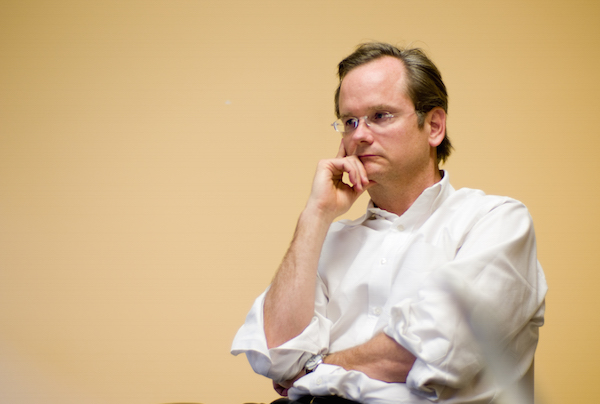
UPDATE 9/6/2016: Lessig's campaign successfully passed the $1,000,000 pledge threshold (I pledged a token amount), and formally announced his candidacy on ABC this morning.
I heartily support Lawrence Lessig’s campaign for president, and there’s almost no public figure I can think of that I would prefer to be president. And that’s just the problem.
Lessig’s campaign is premised on the idea that if he runs and wins, he will doggedly pursue a single, crucial legislative goal: to end the influence of money on politics and elections with a still-in-formation Citizen Equality Act. He maintains (and I largely agree) that without fundamental, structural reforms to our political process, none of the other great challenges of our time can be meaningfully confronted.
If and when a President Lessig achieves this goal, he has pledged to resign from office and hand over his job to the vice-president, whoever that happens to be. (Presumably someone who shares his political views, such as an Elizabeth Warren, Russ Feingold, or some such.) He has promised that he would be a president-in-full while in office, working for domestic tranquility and all that, but has specified that he’d have a mind toward building the foundations of his successor, the sitting vice-president.
It’s confusing, right? Lessig insists that by pledging to resign when his goal is realized, he makes clear that he is serious about fixing the rigged system, and not interested in power for power’s sake. (Is there anyone who thinks that of him? Or could think that?) And there’s a logic to that. He needs to show that he’s not just kicking around some “on my first day in office, my first act as president will be…” bullshit that you hear from every other candidate. He means what he’s saying. He intends to pass this massively important reform, and when he has, he’s out.
Let’s set aside for the moment the fact that, of course, he won’t come close to being elected or nominated, and may not even reach his fundraising threshold to even begin running.
The novelty of Lessig’s campaign is his pledge to resign, and it’s also the campaign’s greatest weakness.
People familiar with Lessig have been clamoring for him to run for public office for years. He had explored a run for Congress for 2008, but backed down when it became clear that he’d have no shot, and his chief opponent was actually not all that bad on his core issues. Offering to run for president, now, as a Democrat, when Hillary Clinton awaits coronation (which will happen, folks), is a thrilling prospect to those who know of him and his work. Yes, his supporters deeply care about the issues he’s made the cause of his life, but they also just really, really want this guy to be president. I really want this guy to be president.
And they sure as shit don’t want him to resign, especially just after he scores his greatest achievement.
We don’t rally around candidates over single issues, really. We rally around a person, or the projection of one, who embodies innumerable qualities, hopes, fears, and possibilities. Who we support for president is tied into our own identities, it’s part of how we tell the world who we are. And the presidency is the closest thing Americans have to a kind of divinely-ordained rulership. We elect presidents that we expect to stay president.
Lessig’s gambit confuses this paradigm. It’s possible that he’d be seeing much more enthusiasm for his run if he never mentioned anything about resigning, because his core backers would be driven by the idea of four to eight years of their guy in charge. Instead, they’re getting their guy for a little while until some other arrangement can be made. Inspiring, it is not. How deflating to you think it was to McCain supporters when in 2008 it was said that he seriously considered pledging to serve only one term?
Lessig's cause is inspiring, but it’s not enough. I want him to run, I want him in the debates, and I want him to win. But if, by some miracle, he did win, I’d want him to stay. Until he pledges that, it’s hard for me to get as excited as I might otherwise be. I expect I’m not alone in this.
[youtube [www.youtube.com/watch](https://www.youtube.com/watch?v=CaqrQz71bMk?rel=0])
How Mars One is Like a Björn Borg Clothing Line
[This post has been updated with some really brilliant insight from the author.] Mars One, the pseudo-pyramid scheme that pretends to be sending astronauts to Mars in the next decade, has inspired a fashion show.
Björn Borg, who I assume is very important in the fashion world, showed off a collection of what is said to be sportswear the serves as “a tribute to the courage and the faith that these people show by going out to the unknown for the evolution of mankind.”
That’s all fine. The idea of human beings risking everything for the longshot chance to live out their days on another planet is, in fact, deeply inspiring. The problem, readers of this blog will already know, is that Mars One is, at best, just shy of a scam. Far too many of its core claims have been shown to be either outright false or gross exaggerations, its stated aims have been declared utterly implausible by even the most optimistic experts, and former would-be candidates for the big trip have revealed the shoddy and ethically dubious process for choosing candidates.
But the idea in abstract? Totally compelling. That, with a heaping dose of laziness, must be why outlets like Space.com and others still repeat the press releases of the Mars One company, complete with references to the alleged 200,000 applicants, which is complete bullshit.
And how perfect a metaphor is this kind of high-end fashion show for the Mars One concept? The Borg collection of clothing is lofty and future-looking, but also entirely impractical and more than a little absurd. The clothes are aspirational, but of course will never be worn by anyone.
It is Mars One.
Forget the boondoggle. How does the Björn Borg “Training for Mars” sportswear look?
I know nothing about the fashion world, so I’ll leave you to be the judge of that. The show was held about a week ago in Stockholm, with Mars One candidates in attendance. Here’s the official promo video from after the fact:
[youtube www.youtube.com/watch
This is clearly not the kind of merchandising Mars One needs to fund their adventure. They need to find some product to be “the official nacho cheese sauce of Mars One” or something.
As a side note, Engadget is going to begin a video series profiling five of the Mars One candidates, and I hope they are going to approach the project with an appropriately skeptical eye. I will be watching with interest. The trailer alone with the wide-eyed, hopeful candidates, and with the parents pained at the idea of their kids disappearing into space, thinking it could actually happen, only makes me more irritated at the scheme.
Here are my previous posts on Mars One:
Consider a superintelligent agent with actuators connected to a nanotech assembler.
I'm reading Nick Bostrom's Superintelligence: Paths, Dangers, Strategies, about the possible capabilities and potential threats posed by rapidly advancing artificial intelligence. It's a little dry at times, to be honest, but then he'll go and say something (in the nonfiction-science-book equivalent of a deadpan) that makes your mind explode. Because you're probably thinking, hey, a superintelligent A.I. could maybe take things over on this planet, and that'd be just crazy! Well sure, but also...
Consider a superintelligent agent with actuators connected to a nanotech assembler. Such an agent is already powerful enough to overcome any natural obstacles to its indefinite survival. Faced with no intelligent opposition, such an agent could plot a safe course of development that would lead to its acquiring the complete inventory of technologies that would be useful to the attainment of its goals. For example, it could develop the technology to build and launch von Neumann probes, machines capable of interstellar travel that can use resources such as asteroids, planets, and stars to make copies of themselves. By launching one von Neumann probe, the agent could thus initiate an open-ended process of space colonization. The replicating probe’s descendants, traveling at some significant fraction of the speed of light, would end up colonizing a substantial portion of the Hubble volume, the part of the expanding universe that is theoretically accessible from where we are now. All this matter and free energy could then be organized into whatever value structures maximize the originating agent’s utility function integrated over cosmic time—a duration encompassing at least trillions of years before the aging universe becomes inhospitable to information processing.
Suck it, Entire Known Universe. You're about to get iColonized.
Can Alphabet Ever Mean as Much as Google Does?
 Google surprised pretty much everyone today when they announced that, well, they weren’t going to be Google anymore.
Google CEO Larry Page (well, former CEO) said in a statement today that he and Google co-founder Sergey Brin would form a new holding company, Alphabet (with the best domain name on Earth: abc.xyz), of which Google would now be a wholly-owned subsidiary, led by Sundar Pichai, who until today was Google’s head of Android and Chrome.
I have some immediate concerns about it, but I should stipulate I’ve only known about this for a couple of hours. Before I get into that, a bit more on what Alphabet is, and what Google is – and no longer is. Page explained how Google would now be one company among many, each focusing on particular areas and industries that were all once housed under the Google banner:
What is Alphabet? Alphabet is mostly a collection of companies. The largest of which, of course, is Google. This newer Google is a bit slimmed down, with the companies that are pretty far afield of our main internet products contained in Alphabet instead. What do we mean by far afield? Good examples are our health efforts: Life Sciences (that works on the glucose-sensing contact lens), and Calico (focused on longevity). Fundamentally, we believe this allows us more management scale, as we can run things independently that aren’t very related.
… Alphabet will also include our X lab, which incubates new efforts like Wing, our drone delivery effort. We are also stoked about growing our investment arms, Ventures and Capital, as part of this new structure.
I should point out first that I don’t have any problem with the idea of a wholesale reorganization of Google. Giving each disparate aspect of the company its own territory, its share of breathing room, could very well be exactly what they need to thrive. I can’t say one way or the other, but it certainly seems that Larry Page, who lusts to be ruler of a magical libertarian island, at the very least could not be content to be the head of a mere search engine company. And Sundar Pichai, though I find him a little frustrating as a spokesperson for his company, is obviously doing wonderful things, as I can only personally attest by my wholesale embrace of Android over the past year and my admiration and fascination with the Chrome OS. So, functionally, this sounds more or less positive.
My concern is more about what Google means to the culture. In a more crass sense, I suppose my concern is over things like “branding” and “marketing,” but I also think it’s about something a little bigger. In the same way that Apple, in the minds of millions and millions of people, stands for something grander and more esoteric than being a really good gadget company, Google is more than a search engine and browser company.
When people think of Google (or at least when people who think about this kind of thing think of Google), the association goes far beyond their products and services, far beyond search results and targeted ads. It’s about all the other stuff, the (gag) “moonshots”: bringing Internet access to the developing world from the air, building automated vehicles to revolutionize transportation, the attempts to lengthen the freaking human life span. All of that, along with Android and Fiber and Chrome and Nexus and everything else.
Now, a whole lot of that, the boldest, craziest, and most out-there, will now be Alphabet. Google, though it will no doubt continue to do great things within its newly confined realm, won’t get the benefit of that association. And Alphabet won’t get the benefit of being Google in name. It’ll be an uphill battle for this new thing to win that kind of mindshare. The insiders will know, I suppose, the tech press of today will more easily make this psychological transition. But for all of those who are just observers or enthusiasts, or even for those who are simply too young to have a long association with Google, there’s an ethos that could be lost.
I could be really wrong. But if it were me, I’d do the reorganization under the Google banner, let the restructuring be an insiders’ story, and keep the (gag) moonshot mojo under the old name.
Consciousness as Middle-Management
Your conscious mind may not be doing anything all that interesting. No, not just you, but like, for everyone. From San Francisco State University:
Associate Professor of Psychology Ezequiel Morsella’s “Passive Frame Theory” suggests that the conscious mind is like an interpreter helping speakers of different languages communicate.“The interpreter presents the information but is not the one making any arguments or acting upon the knowledge that is shared,” Morsella said. “Similarly, the information we perceive in our consciousness is not created by conscious processes, nor is it reacted to by conscious processes. Consciousness is the middle-man, and it doesn’t do as much work as you think.”
I have to say, though this kind of freaked me out when I first read it, having a kind of knee-jerk revulsion to the idea of a more or less hapless consciousness, upon consideration this seems entirely reasonable. One really has to let go of the idea of a kind of mini-self in one’s head that does all the pondering and decision-making, and think more about the mind as the layers of an operating system. Some levels of thinking and processing are “higher” than others, but it’s all still merely reacting to input.
Morsella’s theory seems to me to be analogous to a kind of resource-allocation process in a computer, deciding how much power or memory to give to an application, or what parts of a chip to activate and to what degree (I am not an engineer so this may be a sloppy analogy). What we think of as our consciousness may simply be a process that takes in a stimulus, and then works to figure out how to respond.
Another analogy for the conscious mind that rang true for me was by Michael Graziano, who likened our awareness to a miniature model of a battlefield for a general, complete with little tanks and soldiers, made to represent what was really out there, in order for the general to make decisions. But the general doesn’t have access to the “real” world, just the model he or she’s presented with, and has to rely on that to decide how to allocate resources.
So that’s us, isn’t it? No free will per se, no lofty sentience, just a data-crunching processer that says stop or go to a lot of other processes, relying on an incomplete simulation of the world in which it operates. No wonder we’re such a mess.
The Trump-Loving GOP McCain Helped Create
 I keep starting and then deleting tweets that convey my overall feeling about the whole Trump-v-McCain slap fight going on right now. I know that if I'm not careful, I'll trip a wire. But this morning, via @VideoSawyer, I find an essay by Jim Wright that, while not a tweet, gets the point across very well. You really have to read the whole thing, because it cleverly builds to a kind of crescendo, but here's a taste of what I mean:
Donald Trump is the face of the modern Republican party.
Trump has been polling at the top of the GOP field and you’re just now figuring out what a douchebag he is? Well, that’s just plain hysterical.
Trump badmouthed old Johnny Walnuts, insulted his military service, did he?
And you’re all insulted and outraged? Heh heh, sorry Mr. Veteran, Sir. I have no idea where Little Donny learned that behavior from, no idea. Bad, Donny, bad! You apologize to this faggoty liberal pinko commie traitor right now!
Gee, I wonder where Little Donny learned those words, learned his contempt, learned to Swiftboat a veteran. Gee, I wonder.
Donald Trump is the GOP personified.
Almost as important, though, is Wright's addendum to the post, where he explains that McCain's life as a public figure is entirely fair game, that he has "no use" for the senator from Arizona, but that whatever else, "he went when called."
He may have been the bottom of his class and an admittedly poor pilot, but he met the standards and he did the job. If that's not courage, I don't know what is ...
And I keep looking for a 140-character way to say all of this, and I can't. Trump is the ideal 2015 Republican, all jingoistic bluster, and will thereby say lots and lots of awful things. One awful thing among many is this offensive nonsense diminishing the courage and years of unthinkable suffering endured by McCain when a prisoner of war. But I also want to get across a kind of gentle reminder, that as a politician -- with only the rarest of exceptions when some tiny, shriveled, death-rattle of a conscience emerges from his grizzled gray matter -- John McCain is and has been a cynical, pompous, petty, pandering, entitled, sniveling, backward, show pony who also happens to have the political media machine entirely in his pocket, a machine still under the absurd impression that he is some sort of straight-taking "maverick." (This image was as as transparently false in 1999 and 2000 as it is today, but who cares.)
John McCain, through his behavior as a politician and his enabling of the Republican noise machine, has helped make the modern GOP that now swoons at the braying of an ass like Trump.
So Donald Trump is, predictably, a detestable subhuman, as Wright says, "all 31 flavors of GOP crazy," and they deserve him. But let's not further gild the monumental pedestal, festooned with TV monitors and news tickers, upon which McCain already sits. Enduring five years of torture while in the service of one's country gives you the right to be called hero. Being insulted by Donald Trump does not. Let's keep these things separate, please.
Neal Stephenson's "Seveneves": Thoughts on an Impact Event
 I’ve been deeply affected by Neal Stephenson’s latest novel Seveneves. While I am often a slow and somewhat lazy reader, I found myself taking every opportunity I could to dive back into it. While my favorite novel, Anathem, also by Stephenson, presented a world I wanted to explore more deeply and spend more time in, I found that the story of Seveneves was one that I wanted to tell everyone I spoke to. I didn’t of course because everyone would hate that.
But this is the kind of book we’re talking about, where each event, each decision, and each change of fortune filled with suspense and excitement for what came next, and an enthusiasm to share with others what novel and evocative things I was experiencing.
I’m left with so many thoughts and questions. I don’t necessarily consider the fact that these questions haven’t been sufficiently answered to be a problem or a mistake by Stephenson, but immediately after finishing the novel, they are swirling in my mind, demanding my attention.
Here are some of those thoughts and questions, in no particular order, a few of which are simple questions about “what happened” to certain characters or with certain events that simply aren’t told, and others are more nuanced regarding motivations, character, and connections.
An obvious warning: If you haven’t read the book, I’m going to spoil pretty much everything here. It’s like a nuclear-spoiler bomb. If you have no intention of reading the book, or don’t care about spoilers, there’s probably no reason for you to read this post anyway.
Quickly: In Seveneves, the moon blows up because of unknown "Agent," which humanity learns will kill everyone on Earth within a couple of years due to pieces of the Moon raining down like fire, wiping out everything. So the people of Earth send a select few into orbit with the International Space Station to begin the "Cloud Ark" to live in space until such time, thousands of years later, that they might return to Earth. Lots of awful things happen which lead to there being eight people left, all women, seven of them able to have kids. Through genetic manipulation they propagate the species on an asteroid where they parked the space station. 5000 years later, we see what humanity has become, an orbital species of seven races, only now beginning to dip its toe into repairing and repopulating Earth. Got it?
* * *
The book handled well the curious and difficult balance between the enormous impact of the end of life on Earth and the relatively smaller crises and concerns of the Cloud Ark population. This is a book about those people, not those lost in the Hard Rain, but I would have loved (in another volume or book?) a deeper exploration of how humanity coped with knowledge of its inevitable demise in one fell swoop. My brain would often hang on questions about how governments, economies, and institutions could continue plodding of their own inertia over the two years of preparation. The book cites isolated incidents of violence and riots on Earth (not including the zero-hour standoff in Venezuela), but my mind reels at the idea of a planet full of people all processing their absolutely-assured deaths. Maybe no book could handle it.
* * *
One real triumph for Stephenson in this book is how he brings to bear his penchant for detailed description. In The Baroque Cycle, I was often entirely lost and confused by his meticulous and lengthy descriptions of each setting’s most micro and macroscopic details, or long events with several characters all doing a lot of things I couldn’t keep track of. Anathem occasionally left me a big agog in a similar fashion in terms of architectural descriptions. (Not so much with Reamde which was a non-sci-fi suspense thriller.) But the intricate descriptions of Seveneves almost always served a definitive purpose. Even if at times I felt the lengthy descriptions of minute orbital mechanics were less than thrilling, they almost always paid off, anchoring me in the physics and the challenges they posed, or allowing me to better grasp the enormity and complexity of things like the Great Chain.
* * *
Why did the descendants of the Seven Eves avoid interbreeding to such an extreme degree? While it is explained that Moira finds ways to mitigate the genetic problems of inbreeding, one would presume that as soon as there were sufficient numbers of humans that they would immediately start mixing with the other “families,” increasing the (incredibly small) population’s genetic diversity by traditional means. I understand that the Council of the Seven Eves left us with seven women who each had very strong and differing opinions about the kinds and character of humans they wished to spawn, but I don’t understand how such an ideological point of view (and we are led to understand that “Blue” is averse to ideologies) could have been followed so rigidly, except perhaps by the presumably indoctrinated descendants of Aiïda.
By the time people are sufficiently numerous and have divided themselves into orbital territories in the Grain Chain, it makes more sense that folks might tend to reproduce with others who are like them and in relative proximity – traveling from one part of the ring to another was doable, but not simple. It’s simply difficult for me to understand why such a strict adherence to seven distinct racial lines would or could have been maintained in the first few generations on Cleft.
* * *
What happened to the Mars expedition? I suppose we are meant to assume that whether they got to Mars or not, given the upheaval of the Break and the inability of the Mars mission to subsist for more than a year or so, that they were simply lost. Certainly, the people of A.5000 would have been able to find out whether a human mission to Mars had ever made it there, and it’s never mentioned.
* * *
What is the story of the Pingers’ Epic? How did they manage to change themselves so (relatively) quickly? How many of them are there? What kind of society do they have? Could they have communicated to the people of the Great Chain if they’d wanted to? It is all clearly a book unto itself, not that we should presume that such a thing will ever come into being. I suspect it’s one of those things that Stephenson is just going to leave there for us to wonder about. But given all we hear about how the Cloud Ark was more of a pacifying story for a doomed population than a genuine long-term plan, it does seem like the underwater gambit could perhaps have been not a Plan B, but a Plan A; the actual best hope for humanity that was better-designed and better-prepared.
* * *
President Julia Bliss Fletcher. It’s not entirely clear whether she was always cynical and conniving, but as I always say, one doesn’t become President of the United States without being at least partially sociopathic and messianic. Compound the unspeakable stress and pressure of leading a nation of humans that are all about to die, along with the loss of her own family, and the need to drop nuclear bombs on fellow humans, it’s easy to see how muted or dormant tendencies may have blossomed when the shit really hit the fan (or the Moon really hit the Earth).
That said, as the only successful unauthorized stowaway to Cloud Ark (I don’t count Sean Probst who had his own operation going and immediately sacrificed himself for the larger cause), I’m flummoxed by the leeway granted Julia by Izzy’s command structure. Certainly, bigger problems existed, and surely no one wanted to cause more grief and confusion by “jailing” the just-until-recently President of the Newly Pulverized United States. Still, it seems to me that her obviously violent and desperate route to the Cloud Ark should have led to far more scrutiny of her activities, and that she would face some form of justice for her (and call it what it is) crime. Perhaps none of that would have mattered, and she’d have caused the chaos that she did one way or the other. In a way, Julia was like a second Agent.
An Agent that allowed someone like Aiïda to really fuck things up. Of course with the population of all humanity reduced to eight, I can understand why she was allowed to remain free and alive, but I can’t help but think that considering all the horrible things she’d done, and her obvious hyper-aggressiveness and hostility toward the others, that she might have been considered too great a risk and too great a threat, and done away with before the regeneration of the species got going. Again, I get the need for genetic diversity, but it’s not as thought they really took advantage of that diversity, and who knew when she might snap and just kill everyone?
I also wonder why Moria couldn’t have found a way to carry on Luisa’s genetic lineage along with the others, perhaps with one of the other women acting as a surrogate. Seems a waste of perfectly good DNA.
* * *
And what the hell was the Agent, anyway? This is another one of those things that I’m comfortable not being told – it’s not a story about why the Moon blows up, but what happens next. But of course you can’t help but wonder if the answer will reveal itself throughout the entire book. It never does. Some poking around the web tells me that several folks theorize that the Agent is related to events in my favorite novel, Stephenson’s Anathem, which certainly could be the case. One of the mind-bending things about Anathem is how its multiverse setting could have tendrils into myriad stories. The way Julians are described in Seveneves remind me of the first “aliens” the people of Arbre encounter in Anathem, and if any race was going to make sure they got good seats on the multidimensional spaceship, it was going to be the Julians.
* * *
I was pleasantly surprised by how Stephenson made some of the characters so obviously analogous to known figures in real life. Doc Dubois was, to me anyway, clearly meant to mirror Neal deGrasse Tyson, and Camila was of course a take on Malala Yousafzai (though of weaker character than the real Malala, too easily overcome by charismatic personalities). The eminent scientist near the beginning to addresses the world at the Crater Lake event was probably meant to resemble a less-debilitated Stephen Hawking (and perhaps Dr. Hu Noah was as well?). And if Sean Probst wasn’t Elon Musk I’ll eat my hat.
I also think Stephenson often puts himself into his books (think Dodge in Reamde or Erasmus in Anathem), and it seemed to me that this time he was personified by Rufus. But that’s just a guess. I should say I don’t think Julia is meant to be an analog to Hillary Clinton at all: no one could accuse Clinton of being able to form a cult based on her charisma.
* * *
When Moirans “go epi” and experience changes in their phenotypes, to what extent are they really entirely different people? Kath Two is said to have “died” when the transformation to Kathree begins, but is that accurate or a kind of shorthand? They don’t eject all their memories, it seems, so perhaps it’s not dissimilar to the Trill on Star Trek, continuing on with new identities, anchored somehow with the memories of “another person” that you used to be.
* * *
Oh, there’s so much more. Will the Spacers, Diggers, and Pingers eventually interbreed? Who are the Owners? What is the full story of Sonar Taxlaw (perhaps the best-named character of all time), and what will her life be like now? Are there efforts underway to terraform Mars or other asteroids and moons? When do we get a Seveneves Sid Meier-style turn-based strategy game, and will it run on my current Mac?
And here’s a thing that strikes me about Stephenson more broadly. In all of the books of his I’ve read, as “out there” as his science fiction might get, one thing holds true: The aliens are always us. Be they from parallel universe, hiding in mines, adapting to the deep sea, existing in a virtual world, or simply an ocean apart in preindustrial times, we never need non-human extraterrestrials to “alienate” us. Humanity serves exceedingly well as its own threat, its own contrast, and its own focus of awe.
When emerging from the world of this book, I have a powerful sense of Earth’s fragility. Not just in the sense of what might slam into the planet, but of the permanence (or lack thereof) of the everyday objects around me. I have a sense of gravity as something not to be taken for granted, an ecosystem that is so battered and yet so resilient, and an entire universe that is such a relatively short distance “up.” The stark plausibility of this end-of-the-world scenario (like that of Station Eleven which I’ve also recently read) fills me with a kind of dread for how temporary our situation here on Earth inevitably is, and even if it doesn’t happen for millennia, how it really all could be taken away in one macro or microcosmic event. It made me want to hug my kids, not just for our shared precarious position in existence, but also for the incredible potential they possess to make things like orbital habitats for billions of people possible.
I didn’t want this book to end. I want much more of this story. To help alleviate that pain, I think I’ll dive back into Anathem.
Let's Pick a Decent Pair of Cheap Earbuds
 The bargain I made with myself after my tortuous search for the perfect over-ear headphones, for the purposes of meditational escape and overall awesomeness, was that I could also have a pair of decent earbuds as long as they were cheap. (Such things do exist!) Sometimes the Sony MDR–7506s are too big to take somewhere, or it’s just too hot to put big electronic earmuffs on, and buds become necessary. I have before me three highly-regarded such buds in the sub-$35 price range, and I thought I’d give you my quick verdict on them.
They are the Logitech Ultimate Ears 500vm (which I will refer to as the “UEs”), which I discovered on my own, and the top two picks of The Wirecutter: the Brainwavz Deltas and the Panasonic RP-TCM125 Ergo Fits (which belong to my wife). I tested each pair listening to three specific songs, the acoustic version of Seal’s “Crazy,” The Weepies’ “Take it from Me,” to get a little outside of the acoustic sound but not too much, and deadmau5’s “The Veldt” for some straight-up electronic sounds.
The UEs first retailed at $80 but must not have sold well, and are now available for just over $30, while I got them for under $20 on sale. They are packaged and presented as a somewhat high-end product, complete with lots of padding in the packaging and a uselessly-small case that takes so much effort to cram the phones into, it’s not worth it. They have but one button for controlling play, pause, and advancing tracks, and, weirdly, a volume wheel, which I just keep at full, and never touch.
The UEs were by far the most balanced of the three. They didn’t sound flat or full by any means, maybe “neutral+” would be the way to put it. They kept everything on an even keel with just a touch of “umph” to add to the richness. Details come out pretty well overall, though in “The Veldt” I missed the emphasis on bass that the other two sets presented. The bass is by no means missing, but in most circumstances, the UEs put the bass where it belongs. And if you like a genre of music for its low end specifically, you might miss a little bit of that with these buds.
The Ergo Fits, the cheapest of the bunch at about $13, gave much more low end emphasis, though I could still enjoy some detail. They also struck me as the loudest of the bunch. In “Take it from Me” they felt like bass overkill, though they offered what I’d consider a viable alternative output for “Crazy,” a little beefier than what you’d get from the UEs, but not in the way. The Ergos were probably the best of the three for “The Veldt” specifically, but only by a hair.
The Wirecutter currently considers the Brainwavz to be the best earbuds under $40 (costing about $23), which is why I bought them, and frankly I’m not sure why they won. They don’t so much emphasize the bass as simply allow the low end to push everything else out of the way. In “The Veldt” it was acceptable, as it didn’t overpower too badly, but in “Crazy” they definitely obscured the middle range. In “Take it from Me,” the other frequencies are so muffled by the low end that I was frustrated by what I knew I was missing, straining to hear “around” the bass.
The one thing I do like best about the Brainwavz is the in-line remote, which is actually designed to work with an Android device (very often headphones either have little functionality in their remote, or default to iPhone compatibility).
But as you can probably guess, the best of the three to my ears are the Logitech UEs. None of the buds on this list will blow your mind, but the UEs offered by far the best overall balance, and were head and shoulders above the other two in terms of listening for finer details and overall crispness, though the Ergo Fits had some of that. If the price range of $10–30 is more or less all the same to you, I’d go with the UEs. If $30 seems too much for your purposes, go with the Panasonics Ergo Fits.
Now one more thing: What about Apple EarPods? I count myself among the proud and maligned few who actually think the EarPods are pretty good. The worst thing about them to my ears is the lack of a seal; they just sit there and bop around in your ear because they’re simply not fixed in place. I use EarPods all the time for phone calls and podcast chats (I don’t use the built in mic for podcasts, of course) because they give me decent sound and more awareness of what’s going on around me. That’s also why I use them for running, because anything that gives a seal in the ear canal also transmits every movement of the phone cord to my eardrum. For sit-down listening, when I’m not using my Sonys, I go with the UEs.
Oh! One more important note. I only bought the Brainwavz because my I thought I’d lost my Logitech UEs, when it turns out they only went through the wash in a pair of cargo shorts. And they went through the dryer. And you know what? You’d never know it. This review is based on my listening to them after the washer-dryer event, so that might tell you something.
I'm Special to CNN
Last week, a contact of mine at CNN asked me to write an op-ed for the website on the recent Gallup poll showing an uptick in the number of Americans who would be okay with voting for an atheist for president (now at 58%). I was delighted to be asked, and not a little bit surprised. It had to be somewhat hastily written, but the response to the piece has been great, so here's a chunk of it:
The conventional wisdom has long held that despite the constitutional guarantee of "no religious test" for public office, there could be no greater albatross for a would-be officeholder than to be identified as an atheist. ...[But] nonbelievers have finally moved up a rung. Now claiming the space at the bottom of this particular barrel are socialists, with half of all voters ruling them out entirely. Sen. Bernie Sanders will have his work cut out for him. ...
When asked why Americans were so reluctant to back an atheist presidential candidate, the late Christopher Hitchens would say that there was a time before Ronald Reagan when no one thought a divorced, B-movie actor could be elected president, but such a candidate had to run to test the question.
So, before we can allow these poll numbers to fill the nonreligious with either hope or dread for our political prospects, we have to run the experiment.
We've seen a tiny smattering of atheist candidates and elected officials in the past handful of years, but we need to see more, and at a much higher and more visible level. The more atheist candidates run for office, whether they win or not, the more their atheism stops seeming to voters like an oddity or a novelty.
You can of course read the whole thing here. My favorite bit? The byline, of course, where it says I'm "special to CNN." Aw, CNN, you're special to me, too. Regardless of Don Lemon.
And a small bit of Paul-trivia: When I was an intern at ABC News' Political Unit, David Chalian, Teddy Davis, and Ed O'Keefe were my supervisors and colleagues (each of whom I like and respect very much). Today, they're all at CNN. Maybe I should intern for them again!
Permission to be Unproductive
A thing a sack of problems like me is supposed to do to mitigate crippling anxiety and PTSD is to allow oneself to escape, to decompress. I am notoriously terrible at this. And it’s not just because of the overt crazy from which I suffer, but all manner of tangential hangups. Let me begin with an experience from earlier this afternoon. I was having my twice-yearly dentist appointment, which is really just a chunk of time during which a very nice hygienist scrapes, polishes, and flosses my teeth, wonders aloud at my bizarre lower teeth (long story), and warns me again to floss more.
But because I don’t floss much, portions of this otherwise banal process are rather uncomfortable. I was already coming into the appointment is a kind of emotionally exhausted daze, so this seemed like a good time to practice separating myself from any stressful stimuli, to rehearse something less uncomfortable.
So as that little sharp thingy scraped away at my teeth, and occasionally jabbed my tender gums, I made a point of gazing deeply out the window, trying not to think too hard or intentionally process what I was seeing, but just allow myself to take in the clouds, the colors, and the very slow movement. If I couldn’t see the window, I’d watch whatever tool was being used on me, as its handle went back and forth. I didn’t consider in detail what it was doing, just kind of stayed with it visually.
I had some success with this, and found it somewhat helpful. But the larger point is that I need to make myself escape in this way, become a little “mindless” more often, and at targeted times when I really need it.
I was unable to do it last night. I simply couldn’t allow myself to escape, to divert my attention from my issue-of-the-moment, but I so wish I could have.
My five or six regular readers will know that I have a lot of hangups around how I spend my time. I loathe going to bed, and I resist sleep, seeing it as a kind of “little death.”
I read books slowly, and often nod off, and worry about what other books I’m missing out on, what other things are happening while I’m reading, and what more productive things I should be doing. This is probably why I have tended to favor nonfiction over fiction, because at least with nonfiction I’m “learning” something in a way that is more concrete than I might with fiction.
I have made an attempt to calm myself and escape through music, and that turned into a nutty and obsessive hunt for The Perfect Headphones, documented here. But there again, I feel that allowing myself to sink into a reverie of musical consumption is somehow wasteful, that better uses of my time are beckoning. What they are, I don’t know.
And more of the same with TV and movies. I resist them both because I know that they take up chunks of wakeful time that I could spend on something that matters.
What are these things that matter that I ought to be doing? I guess writing, more creative pursuits, and whatnot. But do I engage in them when I’m not “escaping”? Not usually! Obviously, I do write, I do at rare times make music, but I’m certainly not filling every moment in which I could be watching a two-hour movie with artistic fulfillment. I’m probably just dicking around on the Internet and thinking about phones I don’t have.
But I’m coming around a little. A few weeks ago, because I knew we’d be seeing Age of Ultron soon, I leaned back in bed, plopped my MacBook on my lap, plugged in my headphones (I have stuck with the same ones so far!), and watched the first Avengers movie.
It was about the most therapeutic thing I’d done for myself in years.
What a release! What an escape! For the length of the film I was gone. I was just in this fantasy world, absorbed in something utterly removed from my own life, and when it was over, I felt, well, almost rested, even though it was probably two in the morning.
Most movies aren’t going to be that effective in this way, I know that. But there are plenty that are. I still have hangups about getting stuck in a movie that just isn’t all that good, and wasting those hours. But hell, being a parent, I can really only make time for the best of the best anyway. Experimentation with something stupid or ponderous is a luxury I don’t even have.
I am also being swept away by Seveneves, Neil Stephenson’s newest novel. Fiction! Long, long, epic fiction! Taking me away from me. I still nod off too easily, and I still take way too long to read, but I am trying to let that go.
Because at issue here is not achieving some sort of cultural or content-consuming quota, but to escape. To give my self a chance to get some distance, some room to breathe. So if it takes me all year to read Seveneves, whatever. So be it. (Or so I am telling myself.)
What really needs to happen is for me to be okay with being utterly unproductive, to allow hours to go by without anything to show for it. Not in total idleness, but in active removal. Not “boredom” per se, but engagement in activities or experiences with no industry attached. There can be some productivity as a byproduct, like when I zone out while mowing the lawn or assembling some new shelving piece or something for the house. But that’s incidental. Even in those “productive” times, I’m still not “here.” I’m still getting out of my own head.
This should not be hard for me, but it is. I know I wasted years of my youth on cable and late night TV, that I threw away precious time – after school, on summer vacations – time I could have used to better myself in some way. I just let my brain rot on pop culture, which was itself an escape from other things. But it was a poor avenue of escape, a kind of trap in itself.
But I’ve since overcompensated. It’s time to find the balance. The nice thing is that the only one who gets to decide what that balance is, is me.
That’s also the bad thing.
Threat
What I think people don’t understand about those of us who suffer from intense anxiety, post traumatic stress disorder, and the like, is that having an intense response to something is not a mere intellectual construction that one can be argued out of. We don’t put a few bits of data together and make a rational decision to freak out. The freak-out comes as a result of something our body, including the deepest and most animalistic parts of our brain, has learned, rehearsed, and taken as the unchanging truth: “I am under threat.” And to the person having this experience, it seems entirely rational, plain as day, whether it could be rationally justified or not. The actual facts are immaterial, really, other than how they serve as stimuli to a fight-or-flight response. What doesn’t work is trying to convince us not to be freaked out by pointing out the facts. More data only fuels the fire, gives more things for our brains to be afraid of.
Because what’s happening is physiological, it’s chemical, even though it can express itself in language after it’s been through our brains’ processes. Particularly for PTSD (my particular flavor of crazy), we’ve been “trained” to respond in certain ways to threats (real and imagined) by our past experiences. Some event or series of events have served as rehearsals for our lizard brains, to the point that the perceived threat that kicks the fight-or-flight response in gear becomes The Truth. It is so compelling, in fact, that it also entirely convinces the “higher” parts of our human brains, the ones we like to think of as rational.
What happens then? The rational parts of the brain don’t resist the mania of the lizard brain. Instead, the rational brain goes to work justifying and bolstering what the lizard brain is telling it. Lizard brain says “threat,” rational brain says “drop everything and analyze all aspects of threat; actual and hypothetical; past, present, and future.” In these cases, the rational brain is kind of like CNN when a plane disappears.
I can’t get into it here, but there’s a threat I perceive in my life right now. I am being told my everyone in my life that the threat is very small -- not nonexistent, but not worth obsessing over by any means. I am, nonetheless, obsessing over it, to the point of panic, to the point of a heart pounding against my rib case when I’m merely sitting and watching a movie with my 2-year-old daughter on the couch. I hear a sound, I sense a movement, I think of benign things, it all leads down the same path. I imagine every possible scenario of how this threat might manifest, the ways in which this threat might hurt or kill me, my wife, my kids. I remind myself of how almost anything could set this threat in motion, that its catalyst is entirely unpredictable. That means that this threat could appear at any time, in degrees that range from nuisance to unspeakable horror.
The facts don’t help. Every bit of data given to me about the situation, meant to allay my fears, only gives me further avenues to explore as to how things might unravel. It's like a conspiracy theorist, where every fact meant to disprove a ridiculous assertion only serves to confirm it.
I know that the thing I’m supposed to do, as someone who’s been in a lot of therapy for this kind of thing, is to reverse what my lizard brain has rehearsed. To rehearse a new automatic response. But it has to go in the opposite direction of the original “bad rehearsal.” Instead of the experience being dictated by my lizard brain, and into my rational brain, I have to begin in my rational brain and work it backward. Instead of letting my lizard brain determine my physiological state (the heart pounding, the tightened muscles, the widened eyes, the quick breathing, etc.), I have to let my rational brain tell my body what to do, which should in turn “rehearse” my lizard brain to a new status quo. It’s incredibly difficult.
And it is made all the more difficult because, remember, my rational brain is already in the can for the worldview of the lizard brain. My rational brain believes that the threat is real and ever-present, and for me to tell it something contrary to that feels like an enormous lie, a sick joke, like trying to convince yourself that Santa Claus is real, or that two plus two equals banana. Everything inside me tells me that the threat is real, and all attempts to convince me otherwise are wrong, or worse, additional aspects of that threat.
The only solution to that paradox, frustratingly, is more and more rehearsal of the “correct” outlook. Even if every fiber of my being believes it to be a lie, the rehearsal will, in theory, eventually begin to take. My lizard brain will learn from the adjustments in thinking, in breathing, in refocusing. It will resist, but by rehearsing, it becomes the new normal.
But it is so hard. It is so hard. And that threat is right there, guys. It’s right there.
I Thync This Might Be Bullshyt
There’s been a little bit of curious excitement over a new product called Thync, a wearable module that is intended to reduce stress, induce relaxation, or energize through stimulation of the brain. Here’s how they put it:
Thync uses neurosignaling to activate specific cranial and peripheral nerves to influence this balance and shift you to a state of calm or give you a boost of energy in minutes. …
Neurosignaling is the coupling of an energy waveform to a neural structure (receptor, nerve or brain tissue) to modulate its activity.
Neurosignaling waveforms or Vibes consist of precise algorithms that bias activity of the sympathetic and parasympathetic nervous systems, so that you can enjoy a shift into a more energetic or relaxed state.
Why yes, in case you’re curious, I also think it sounds like bullshit.
Okay, maybe bullshit is too strong a word, especially since I’m not qualified to judge the science behind it. It wouldn’t surprise me if something like this could be expected to have some kind of relaxing effects, in a way that just barely stops short of a placebo effect. Heck, even I sometimes use those “binaural waves” apps on my phone, not because I actually think it’s manipulating my brain waves, but because it makes for good white noise when I just need to shut the world out and chill for a bit.
My guess is that, at best, Thync does something like that; distracting you enough with the fact that you have a svelte, expensive doohicky on your forehead that zaps you a little. If nothing else, it’s something to think about other than whatever’s bothering you.
Kyle Russell at TechCrunch tried it out, and certainly had some sort of experience:
While I was warned that Thync might not work the first time, a few minutes into my first session (using the Calm setting) I felt a wave of sluggishness pass over me. I had some difficulty putting words into a coherent question for [Thync CEO Isy] Goldwasser, and felt a strong urge to take a nap that lasted until I got home. While I may have cranked the settings too high for my first go, the impression I got was that it would be great for falling asleep, not de-stressing at the office.
There’s a big red flag for me right at the very beginning of that quote. Why woudn’t it work the first time? Either it’s “neurosignaling to activate specific cranial and peripheral nerves” or it’s not. Unless human brains have some sort of neurosignaling-callus that needs to be worn down first, and I’m going to assume they don’t, it should just work the first time and all subsequent times.
But how does one explain Russell’s sudden onset of sluggishness? The possible factors that have nothing to do with Thync are endless, but it also seems perfectly reasonable to me that the very fact (and, frankly, stress) of having a gadget on your head that you’re told is going to zap your brain would certainly cause you to expend some mental and emotional energy, and zonk you out a bit. Russell says that the device emits “a wavy, tingly feeling on your upper forehead and the front of your scalp” that “would definitely take a few uses before it stops feeling weird.” Again, this is what I’d say is “just short of” a placebo effect. Something is happening, but not what they say is happening.
Encouragingly, Thync posts an actual test it conducted on the product. However, from my admittedy strained and untrained gleaning of the results, it didn’t seem like the Thync product induced any states that were meaningfully different from “sham treatment.” There was definitely an uptick in test subjects saying they were more relaxed than not compared to “sham,” but nothing that appeared all that convincing to me, and certainly not spend-$300-on-a-cranial-dongle convincing.
(I’d post some images of graphs from the study, but they require permission to be granted for that, and whatever.)
And here’s another thing: It seems like what Thync’s CEO tells Russell at TechCrunch is a little different than what is being sold on the website:
During the demo, Thync co-founder and CEO Isy Goldwasser explained that the module wasn’t directly stimulating neurons in my brain (that would be too damn weird for me to try, to be honest). Instead, it uses tiny pulses of electricity to stimulate the skin at your temple, which then activates the instinctual fight-or-flight response in your brain to indirectly affect emotional response.
Well, there are lots of things that can stimulate skin and activate fight-or-flight, and most of them are free.
I frankly don’t understand the science or the published study sufficiently to make any kind of authoritative judgment, but it sure smells like some kind of ophidian secretion.